
Charlie Chaplin is funny.

Ziad Doueiri’s “The Attack” is really about two attacks. The obvious one is a suicide bombing in a Tel Aviv restaurant that kills 17 people. The less obvious one is a the way that bombing tears through the fabric of a marriage.

Maybe “Love Crime” was too much in director Brian De Palma’s wheelhouse. The French thriller, about a pair of female executives whose struggle for power turns murderous, had a Hitchcockian gloss to it that the director of “Dressed to Kill” and “Blow Out” would find hard to resist.
But De Palma’s remake, “Passion,” feels like someone else’s idea of a Brian De Palma homage, gorging itself on familiar tropes — masks, surveillance cameras, dream sequences– and failing to build either tension or interest.
Noomi Rapace plays Isabelle (Ludivine Sagnier in the original), a bright young creative in a Berlin-based ad firm that works with a big mobile phone client. Isabelle comes up with a brilliant advertising campaign for a new camera phone, which her boss Christine (Rachel McAdams) brazenly takes credit for at a meeting. “It’s not backstabbing, it’s business,” Christine calmly explains when confronted. She’d expect Isabelle to do the same in her shoes.
Isabelle accepts the explanation at least at face value, but a power struggle is on, involving falsified incriminating emails, surveillance tapes and competition over one boyfriend (Paul Anderson). Isabelle starts to spiral into depression and paranoia. Christine appears to have destroyed her — but Isabelle may have a couple of tricks up her sleeve.
De Palma has some undeniably ravishing sequences, most notably the murder of a major character split-screened and choreographed to a ballet. But they seem like finger exercises in a movie that never justifies its existence. The buttoned-down Rapace doesn’t exude much charisma, and McAdams has more of a “Mean Girls” pettiness than the dragon-lady menace that Kristin Scott Thomas brought to “Love Crime,” making her not much of an adversary. But you get the sense De Palma is so busy setting up shots that he doesn’t notice that his characters aren’t connecting.
At least with “Redacted,” De Palma’s controversial found-footage film about the Iraq War, he could be forgiven for at least trying something different. Here, he’s doing the same thing he’s been doing for decades — only not nearly as well.
The Blu-ray edition from EOne Entertainment certainly makes De Palma’s images look good. The only special feature is a featurette that seems aimed at people who haven’t seen the film, not those who have just watched it.

In 1994, director Neil Jordan adapted Anne Rice’s “Interview with the Vampire” for the screen. It was elegant and clever, if a little overwrought and overburdened with star power (Brad Pitt and Tom Cruise). But one thing it definitely wasn’t was a horror film. There were no jumps or jolts to be had, but rather a moody, mordant take on the pluses and minuses of immortality.

Autumn. A time for watching the leaves turn, making spiced apple cider on the stove, and, of course, engaging in bitter recriminations with your parents.
At least that’s how Ingmar Bergman does autumn (and I’m not sure about his opinion on the leaves or the cider) in “Autumn Sonata,” which the Criterion Collection just re-released in a new Blu-ray edition with new bonus features not on the original DVD version. This is wrenching family drama as only Bergman can do it.
The 1978 film is also notable for being the only one of Bergman’s films to feature Sweden’s other famous Bergman, Ingrid. She plays a world-renowned concert pianist, Charlotte, who comes home to visit her eldest daughter Eva (Bergman favorite Liv Ullmann) after a long absence. Ingrid carries herself with an imperious glamor, her star power so bright it dominates the screen, and Ullmann has deliberately dowdied herself up as the repressed Eva. We learn that Eva has been taking care of Charlotte’s other daughter, the severely disabled Helena (Lena Nyman).
At first, relations are polite but wary between mother and daughter, but as the evening wears on, politeness gives way to honest expressions, as the emotions Eva has been bottling up since childhood come pouring out. The film turns into a lacerating mother-daughter war, the air thick with accusations and recriminations, the mousy Eva growing stronger and more fiery as Charlotte seems to physically retreat, horrified at the truth of her family that she kept ignoring, all those years out on tour. Meanwhile, Helena writes in inarticulate pain in the back room, a living symbol of Charlotte’s neglect.
Although the film has a couple of the characters, including Eva’s husband providing opening and closing narration, this is really a two-character film. Bergman and Ullmann give fearless, bruised performances, locked in bitter combat, horrified at the truths they discover about themselves. Bergman’s descent into confusion and regret is most pronounced (it was her final film role, and she was nominated for an Oscar), but it wouldn’t work as well without Ullmann’s mirroring performance, as quiet Eva finds her voice, and can’t stop using it. One would assume our sympathies would lie with Eva, the abused and neglected daughter, but she’s no saint, warped by a lifetime of silent frustration.
Bergman’s camera seems to inch in closer and closer as the wounds go deeper and deeper, and the rich autumnal colors (which glow in this new 2k transfer) seem to almost mock the emotional rawness of the content.
So how was this great meeting of the Bergmans on set? “Terrible,” a “headache,” a “nightmare,” Ingmar Bergman says in a 2003 interview included in the bonus features. For the first few days, Ingrid Bergman’s performances on set were far to big and theatrical, and Ingmar feared the movie would be a disaster. Finally, he showed her the dailies, and blessedly, she saw the error of her approach and adjusted downward. The shoot was still contentious between the two, but Ingmar got the performance he needed.
The Criterion Blu-ray edition also includes an exhaustive (as in three-and-a-half-hour) documentary on the making of “Autumn Sonata,” an audio commentary by Bergman scholar Peter Cowle, and, new to the Blu-ray, an interview conducted this year with Ullmann about the movie.

A man stumbles, shirtless, bloody and shell-shocked, among garbage piles and wild dogs in a remote part of Cambodia.
How he got there, what it meant, and how he’ll with it are the central questions of the Australian thriller “Wish You Were Here.” Writer-director Kieran Darcy-Smith tells his tale in a deliberately fractured manner, jumping back and forth between moments during a vacation in Cambodia and the aftermath back home in Australia. The result is a film that is exactly the sum of its parts, no more and no less.
Dave (Joel Edgerton) begrudgingly agreed to go on that vacation with his wife (Felicity Price), her younger sister (Teresa Palmer) and the sister’s new boyfriend (Antony Starr). We catch brief, color-saturated glimpses of them dancing in the streets, taking drugs. But back home in Australia, everyone seems haunted and wary. Well, not everyone — the boyfriend didn’t come back.
What happened to him is revealed in dribs and drabs of information, as Darcy-Smith cuts back and forth between Australia and Cambodia, What anchors the film is Edgerton’s performance. So often called on to play masculine, even menacing figures in “The Great Gatsby” and “Animal Kingdom,” here he’s very convincing as a scared and possibly guilty man. It’s a canny performance, because Danny can only reveal emotionally to the audience at a given point in the movie only what the plot has revealed dramatically.
Finally, the film gives us our answer, but then shuffles off the stage rather quickly without dealing with the consequences. The result is a film that’s engrossing when you watch it but, like a vacation taken a long time ago, quickly dissipates in your memory.
The Blu-ray release, which captures both the fiery reds and oranges of Cambodia and the cool blues and grays of Australia, includes making-of featurettes and cast interviews.
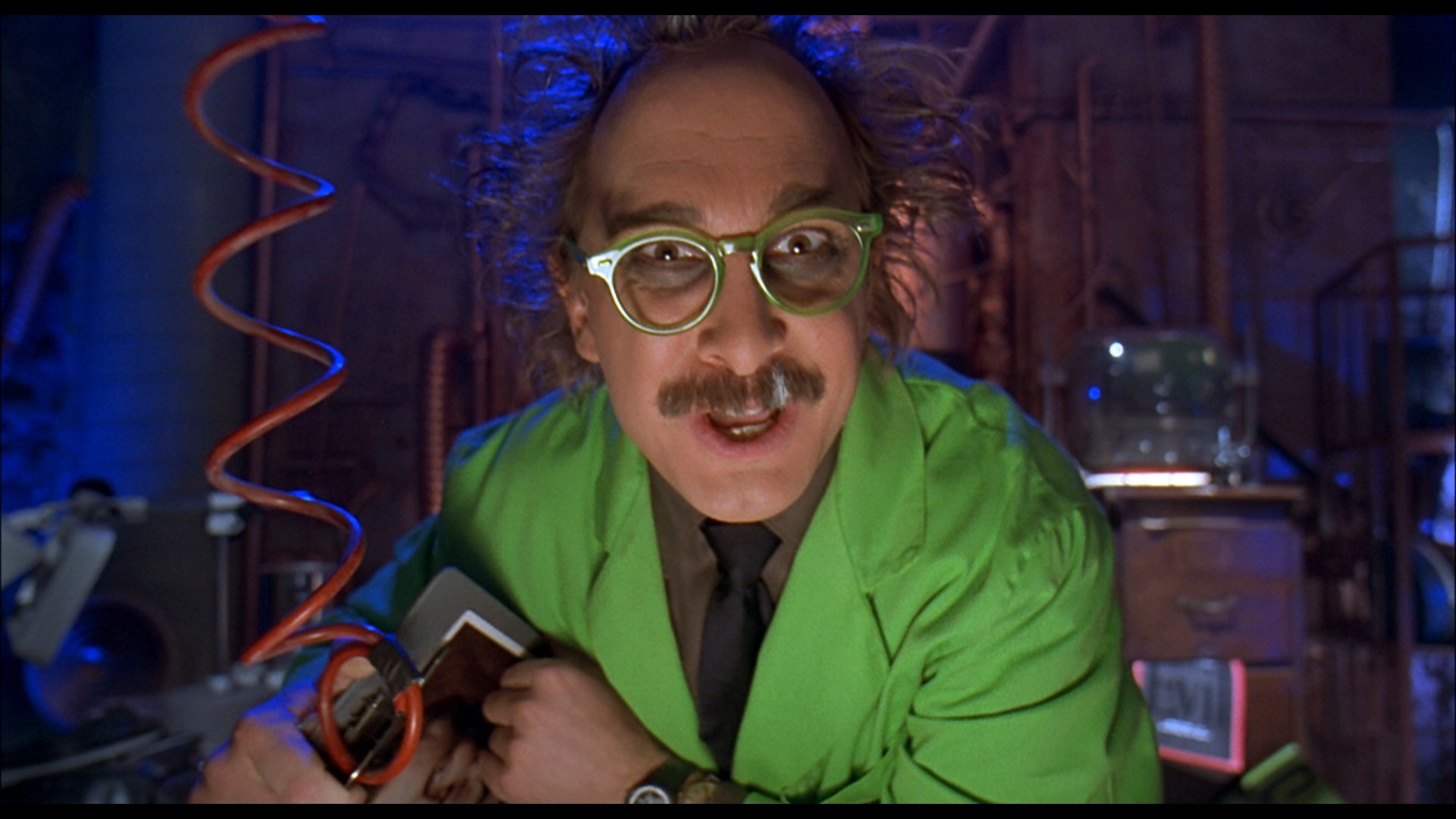
It could be the plot to some cheesy sci-fi movie that Mike and the ‘bots would make fun of on “Mystery Science Theater 3000” — two identical alternate universe, one where everything is happy and cheery, the other where we see those exact same events through a much darker and more sinister lens.
Those two universes, as it happens, are the two “making-of” featurettes that appear on the Shout! Factory DVD/Blu-ray release of “Mystery Science Theater 3000: The Movie,” which just came out this week after a long, long wait from fans. Taken together, the extras provide an instructive lesson in dabbling with potent forces of evil — in this case, a major motion picture studio.
The movie came out in 1996, somewhat bridging the gap between the cult TV show’s Comedy Central and Sci-Fi Channel years. Universal Pictures thought they could turn the TV show into a cheap but profitable franchise for themselves, while the creators of the show thought that successful live “riffs” of the show before audiences proved that it could work in a group theater setting.
The first featurette, released at the time of the film’s release, shows a Satellite of Love crew happily working on the film. The second, made for this Blu-ray release, delves into the constant struggle that the MSTies had with Universal executives to make the film. Having signed onto the film, Universal insisted on having input into seemingly every decision, including approving or vetoing individual jokes (a Bootsy Collins reference was changed, bizarrely, to a Leona Helmsley reference) and test-screening rough drafts of the film to death. (It’s grimly ironic that the movie trailer touts that the MST3K crew “can make jokes without a censor” in the film, since the meddling from Universal was much more pervasive than anything the show had gotten from Comedy Central or Sci-Fi.)
Michael J. Nelson, Trace Beaulieu and Kevin Murphy, along with showrunner (and UW-Madison grad) Jim Mallon, complain openly about the arduous process, and it’s clear that they regard the finished product as a compromised thing. “The joy of doing this was strained terribly through this odd, arbitrary process.” Mallon said.
That said, the movie itself comes off, as Murphy puts it, as a “better-than-average” episode of the TV show, with significantly better production values given to the host segments, which were shot on a much bigger studio space. The movie that the guys riff on, “This Island Earth,” is actually a pretty good scifi movie, and overall the image pops on Blu-ray in a way most episodes of the TV show just wouldn’t. The release also includes deleted scenes (axed by the studio, naturally) and you get a taste of the cover version of the MST3K theme song done for the movie by Dave Alvin.
In the end, I’ll bet the experience of making the movie was so painful for Mike and the gang that I doubt they’ll ever pop in a copy of the Blu-ray release. But for fans, its an essential part of the collection, and a surprisingly revealing look at the hazards of letting outsiders into your strange little world in the hopes of achieving mainstream success. Better to stay on your own Satellite of Love, unreachable by the mad scientists down below, doing it on your own terms.
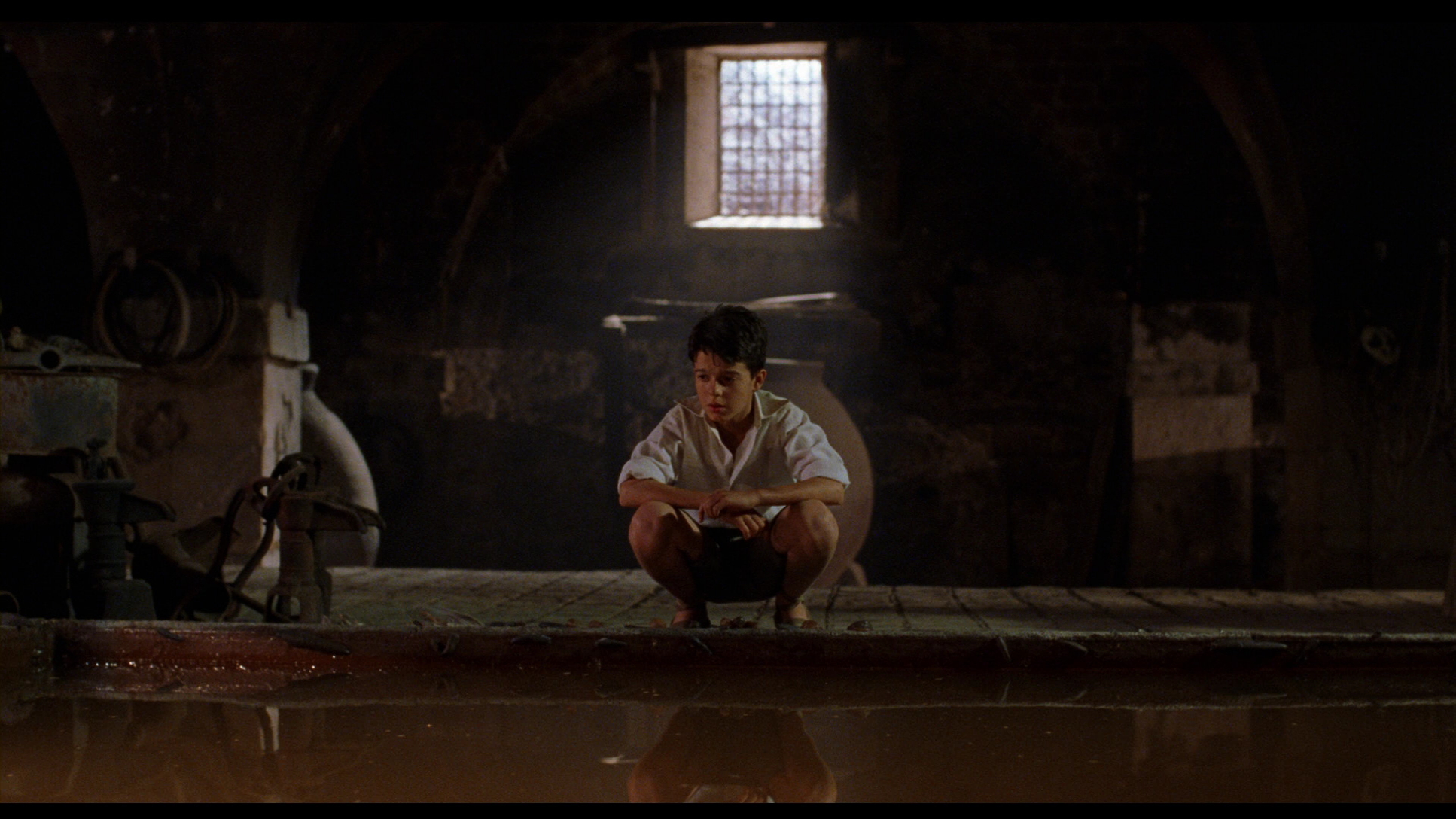
The new Criterion Collection edition of Guillermo Del Toro’s “The Devil’s Backbone” is one of my favorite Blu-ray releases in a while, because it does exactly what you want a “special edition” to do. It takes a great film and opens it up for the viewer, letting you delve into its influences and its secrets. There’s a BD-ROM “Director’s Notebook” feature that allows the viewer to “page” through Del Toro’s notebook of sketches and outlines for the film, and that spirit, clearly overseen by an enthusiastic Del Toro himself, carries through to the entire project.
The film is one of Del Toro’s best, worlds away from the sturm and drang of this summer’s “Pacific Rim,” but just as concerned with the elemental struggle of good and evil. This time, though, the setting is a remote orphanage in 1938, during the Spanish Civil War. An unexploded bomb is embedded in the courtyard, but the children and caretakers have learned to ignore it and go about their business. A new boy, Carlos, comes to the orphanage, and starts peeling back the orphanage’s secrets, which include a sadistic caretaker and a ghostly boy, his head cracked like that of a porcelain doll, wandering at night.
“The Devil’s Backbone” is a ghost story, full of shudders and shocks. It’s also a horror film, but the horror doesn’t necessarily overlap with the supernatural elements. Instead, the horror comes in the cruelty committed by one person onto another (personified by the psychopathic, handsome caretaker), and the fear, especially from a child’s perspective, of living in a country being ripped apart by violence. There is a deep sadness underlying “Devil’s Backbone” — the loss of innocence, the folly of resistance, the pain of regret, the need for compassion. Del Toro says in one of the Blu-ray extras that the film is meant to “rhyme” thematically with his more famous “Pan’s Labyrinth,” which also mixed unearthly wonder with earthly cruelty.
The DVD includes a chatty and thoughtful commentary track from Del Toro, of course, but you can also enable a feature that allows you to see thumbnail sketches Del Toro drew of particiular shots and images while the film is playing. The supplements include extensive interviews with Del Toro and other cast and crew, as well as a very interesting interview with a Spanish Civil War historian that puts the action of “Backbone” into historical context.
I’m glad Del Toro gets the clearance to make big, fun movies like “Pacific Rim,” but I hope he always ping-pongs between blockbusters and more personal projects like “The Devil’s Backbone.” I can’t imagine another filmmaker making a movie like this, and the Criterion edition shows how that passion infused every frame of the film.

Eran Creevy’s “Welcome to the Punch” is like a Hong Kong action movie set in London. The film’s look — all gleaming surfaces, blue lights and chrome — resembles Hong Kong or Shanghai much more than the grimy, gritty London we usually see in British crime films, like Guy Ritchie’s earlier movies. But a more central connection to Hong Kong cinema is the film’s preoccupation with the permeable, shifting line between good and evil, how cops and criminals can find more in common with each other than they expect.
Which is not to say “Welcome to the Punch” is particularly deep, but it is a lot of fun if you like that sort of thing. I kinda do. James MacAvoy, scuffing up his image between this and “Trance,” plays Max Lewinsky, a dogged London detective trying to catch master bank robber Jacob Sternwood (Mark Strong). In an atmospheric prologue, Lewinsky nearly nabs Sternwood and his masked, motorcycle-riding cohorts as they rob what looks like The First Bank of Tron. But Lewinsky gets shot in the leg, and Sternwood gets away.
Now it’s three years later, and Sternwood has been enjoying retirement in remote Iceland. But he learns that his grown son has been arrested and injured, and decides he needs to come back to London to help. Lewinsky, still bitter over his leg injury, sees this as the perfect opportunity to finally get Sternwood once and for all. But the pair find that Sternwood’s son may have been part of a larger conspiracy involving the police department, a fanatical mercenary (Johnny Harris), and a shipping container full of guns. Reluctantly, inevitably, they join forces.

There’s not much new here, but the familiar material is elevated by an unusually strong cast. Strong gets cast as villains all the time (“Sherlock Holmes,” “Kick-Ass”), but he seems to relish the chance to give his baddies a little nuance, such as the fundamentalist torturer in “Syriana” or the exasperated drug smuggler in “The Guard.” (He finally plays the protagonist on the new AMC series “Low Winter Sun,” albeit a Detroit detective who kills a fellow cop.)
Here, he’s the classic criminal with a code, and his cool, controlled demeanor plays off well against MacAvoy’s vengeful hothead. Peter Mullan is funny and menacing as Jacob’s loyal sidekick, David Morrissey of “The Walking Dead” brings humanity to the typical police chief role, and Andrea Riseborough is very effective in a small role as Lewinsky’s partner. And Harris, who I had never heard of before, is terrifying as the sad-eyed mercenary, convinced his murders are part of a higher calling.
The movie is full of well-staged shootouts and car chases, in office buildings and nightclubs and shipyards. But the best action scene of all in “Welcome to the Punch” is a bravura four-way standoff inside an old lady’s tiny sitting room. in which the tension builds exquisitely, finally exploding in a shootout that takes about four seconds in real time, but is drawn out into epic slow motion. It’s a fantastic scene.
The shimmering London locations looks great on the Blu-ray edition, which also features a making-of featurette and several promotional interviews with the cast. “Welcome to the Punch” isn’t up to the level of the great Hong Kong action films, or the great British crime films, that it clearly admires. But it’s a successful and enjoyable melding of the two styles.

When you first encounter William Golding’s “Lord of the Flies,” the political allegories go flying right over your junior-high head. They certainly did for me when I wrote a book report on Golding’s dystopian classic in ninth grade, preferring to focus, as many first-time readers do, on the excitement and novelty of a group of kids crash-landing on a deserted tropical paradise.
(Our teacher, like many before her, seemed to favor a slightly different interpretation, that the book confirmed her belief that we were a classroom of savages that should never be left alone. One extended trip to the mimeograph machine in the teacher’s lounge might result in finding a pig’s head on a stick when she returned if she wasn’t careful.)
I even used still photos from Brook’s 1960 film in my report. Later on, I re-read the book, saw the 1990 version and connected better with Golding’s theme of the savagery underneath the surface of civilized man, lurking and waiting for a reason to surface.
But I didn’t properly understand the context of “Lord of the Flies” until I saw the Criterion Collection’s new edition, out on Blu-ray this month. The aftermath of Britain’s in two world wars, where millions of young men were sent to suffer, and to do, things no man should ever do was still fresh.
The opening credits make that explicit, with still photos bombers juxtaposed against the laughing faces of schoolboys. I had forgotten that Golding’s story takes place against the backdrop of a third world war, and the planeload of schoolboys has been evacuated from a devastated Britain. The plane crash-lands on a desert island (Puerto Rico in the film), only the children survive.
The boys attempt to create a democratic and fair society, but are undermined by a splinter faction that pursues a more violent and dictatorial path. (Interestingly, the totalitarians are a group of choirboys, and seeing them march down the beach in full regalia is surreal and eerie.) Order breaks down, the strong subjugate the weak through intimidation and fear, and Golding’s bleak vision of the human condition is complete.
The new 4K restoration really brings out the rough grittiness of Brook’s film, which he shot documentary-style entirely on location using non-professional actors. The use of non-professionals is something of a mixed bag; some of the kids are simply not good actors, and deliver dialogue with the stiffness of performers in a school play. But, on another level, there’s something effectively unnerving about that stilted quality, as if these really are boys lost in the wild, and not characters in a movie.
The extras include a commentary track from Brook, cinematographer Tom Hollyman and editor Gerald Feil, as well as a deleted scene and behind-the-scenes footage. The Blu-ray also includes newer interviews with Brook and Feil, and a 1980 talk show segment featuring Golding talking about his inspiration for the film.
There’s a flatness, a matter-of-factness, to Brook’s version that loses the feverish quality of the source material, but that appears to be by design. The book invites the reader to look deep into the darkness of man’s soul, while the movie puts that darkness on full display, in bright sunlight, in a world of laughing, fighting boys.
 Madison Movie