“Blackfish”: Plumbing the depths of animal cruelty

blackfish

“Blackfish” opens Friday at Sundance Cinemas. PG-13, 1 hour 23 minutes, three stars out of four.

There are moments in “Blackfish” as suspenseful and scary as in any horror movie you’ll see this summer. Take, for example, the chilling sequence in which a killer whale takes a veteran SeaWorld trainer’s leg in his mouth and drags him down to the bottom of the tank. He looks like a beagle with a chew toy in his mouth — you can’t tell whether the whale is being malicious or being playful — and the whale surfaces just long enough for the trainer to catch his breath, his consciousness fading, before dragging him down below again.

That trainer survived, but others weren’t so lucky. Gabriela Cowperthwaite’s disturbing documentary isn’t meant to titillate us with such sequences, but to show audiences the moral and physical cost of keeping killer whales in captivity — a cost paid by both the whales and their trainers.

The movie centers around the 2010 death of another veteran trainer, Dawn Blancheau, who was dragged under water by a male whale, Tilikum, during a performance, mutilated and killed. (One trainer vividly remembers being told that day of her death, and then the chilling words, “He’s still got her.” SeaWorld insisted that the death was the result of an error on Blancheau’s part, first circulating the erroneous story that she fell in the water, then that Tilikum grabbed her by the ponytail.

Both stories are belied by the videotape (which “Blackfish” mercifully spares us), and the Department of Labor’s Occupational Safety and Health Administration successfully sued SeaWorld. Now, trainers have to be separated by a barrier when they work with orcas — SeaWorld is appealing.

blackfish-1_rgb

But “Blackfish” digs back into Tilikum’s history, and finds that Blancheau was the third trainer Tilikum had killed over a 20-year period. Contrasted with cheery promotional videos of SeaWorld from the ’80s and ’90s, we’re presented disturbing testimony of how Tilikum and other killer whales have been treated in captivity — held in concrete pools, separated from their parents, sometimes brutalized by the more dominant female whales.

Much of this testimony comes from OSHA, but much of it also comes from former trainers, once cheery spokespeople for SeaWorld, now feeling disillusioned and betrayed by the company. The upshot of the film is that killer whales don’t attack trainers because of some predatory nature, but because they’ve been psychically warped by such treatment.

SeaWorld declined to be interviewed for “Blackfish,” a decision they may be regretting, now that the company has tried to launch an aggressive counteroffensive against the film. It is undeniably true that millions of people have walked out of a SeaWorld park over the last forty years with a greater appreciation for marine life. It is also undeniably true that those people have also spent a lot of money at SeaWorld. The question that “Blackfish” provokes, viscerally, is whether the education and entertainment for visitors, and profits for the company, are worth it if the animals are mistreated and unhappy. After watching “Blackfish,” the answer is crystal clear.

“We’re the Millers”: The family that smuggles together snuggles together

we-re-the-millers-picture05

“We’re The Millers” opens Wednesday at Point, Eastgate and Star Cinema. R, 1:40, two and a half stars out of four.

There’s something almost refreshingly mean-spirited about the first few minutes of the raunchy comedy “We’re the Millers.” Our hero, David (Jason Sudeikis) is a Denver pot dealer who is utterly selfish and snarky. Our heroine, Rose (Jennifer Aniston) is a weary, flinty stripper who has seen too much. Add in Emma Roberts as a foul-mouthed homeless teen and you’ve got one of the least likable collections of characters since your average Todd Solondz movie.

“We’re the Millers,” which was co-written by DeForest native Sean Anders, successfully rides on that ill will for a while. David is hired by his drug supplier Brad (Ed Helms, playing a satisfyingly menacing version of his usual grinning goofball) to transport a “smidge-and-a-half” of marijuana from Mexico to Denver. The scruffy David is sure he’ll be caught at the border, but comes up with an idea. He’ll clean himself up and hire Rose, Casey and a sweet but dim teen named Kenny (Will Poulter) to play his family, a clean-cut All-American family taking the RV out for their summer vacation.

Of course, it doesn’t all go as planned — that “smidge-and-a-half” turns out to be two metric tons, crammed into every available space in the RV. And there are the usual comic setpieces involving a corrupt cop (Luis Guzman), a nasty tarantula, and most entertainingly, a fellow straight-arrow couple (Nick Offerman and Kathryn Hahn) who think they’ve found fellow suburban travelers in the Millers. Some of it works better than others — Hahn and Offerman are very funny as the naive Midwestern couple looking to spice up their marriage — but what carries it through is the sheer meanness of the Millers. Beneath their polo shirts and pastel skirts, they snipe viciously at each other along the way, and the best parts come when their fighting aligns with that of a real family, with Sudeikis as the harried dad and Roberts as the rebellious teen. “I will turn this RV around RIGHT NOW!” David thunders. “No drugs for anyone!”

But, inevitably, things have to turn sweet, and this fake family has to start appreciating each other as a real family. And that’s where “We’re the Millers” falters; trying to turn such acerbic raunch into a sweet redemptive comedy is like trying to negotiate an RV around a hairpin turn, and “We’re the Millers” just can’t make it. Sudeikis in particular does sour a lot better than he does sweet, and his attempts at the end of the film to keep his “family” together just do not ring true.

Up until then, though, “Millers” is good dirty fun. And if it in any way reminds you of your own family road trips, a little group therapy might be in order.

“Percy Jackson: Sea of Monsters”: By gods, this is an unnecessary sequel

Percy-Jackson-Sea-of-Monsters-Image-01

“Percy Jackson: Sea of Monsters” opens Wednesday at Point, Eastgate, Star Cinema and Cinema Cafe. PG, 1:49, two stars out of four.

And you think you’ve got daddy issues. What if you were the half-blood son of the Greek god Poseidon, ruler of the sea? Every time you needed to have a heart-to-heart with Pops, you had to go talk to the ocean. And, even more humiliatingly, the ocean never talks back.

That’s the predicament that Percy Jackson finds himself in in Rick Riordan’s wildly popular series of young adult novels, now being adapted for the movies. But the second film, “Sea of Monsters,” seems to be a downmarket version of 2010’s “The Lightning Thief.” While the highly similar Harry Potter books and films seemed to deepen and darken their themes with every film, Percy seems to be going shallower and flashier.

Percy and other demigod offspring are safely esconced at Camp Half-Blood, run by Dionysus (a hilarious Stanley Tucci) and centaur Chiron (Anthony Head, taking over for Pierce Brosnan from the first film.) Percy and his friends, including Alexandra Daddario as Annabeth and Brandon T. Jackson as a wisecracking satyr. But when the magical barrier protecting the camp starts to falter, Percy pulls his friends into a quest to find the Golden Fleece to heal it.

Which sounds exciting, but what “Sea of Monsters” really skimps on is 1. Sea and 2. Monsters.  Instead, there’s a lot of backstory and exposition as Percy and his team make their way to the sea, lots of stuff about destiny and sins of the fathers that you can’t believe couldn’t have been streamlined. One bright spot is a stop off to see Hermes (a witty Nathan Fillion) who runs sort of a UPS for Greek gods. (When he’s omnipotent, brown can do an awful lot for you.)

Percy Jackson:  Sea of Monsters

The monsters include a cyclops, a mechanical bull and, most niftily of all, a werewolf-like creature with a scorpion’s stinging tail. But Percy spends more time fighting fellow half-bloods, especially the sneering Luke (Jake Abel), who wants to use the Fleece to raise a vengeful god to destroy Mount Olympus. There’s fun to be had here — the tone is much lighter and jokier than the Harry Potter films — but there’s never a sense of stakes, that any of this really amounts to anything more than a CGI distraction.

Which is too bad, because Lerman is a very likable and unassuming hero (he was great in “The Perks of Being a Wallflower”) and is clearly eager to go a little deeper into Percy’s emotions, to wrestle with the implications of having a deadbeat dad who rules the ocean. Tucci is also highly enjoyable, his Dionysus looking like a ’70s porn director, chafing under a curse by Zeus that turns all his beloved wine into water. “The Christians have a guy who can do this trick in reverse,” he bemoans. “Now THAT’S a God!” But they both seem stranded in a franchise that, for all its grand talk of destiny and omnipotency, seems to be trying to get away with doing it on the cheap.

By the way, I saw “Percy” in 2D, and hear that the 3D version is one of the worst 3D conversions since the first “Clash of the Titans.” It’s utterly unnecessary.

“The Canyons”: The movies are dead. Long live the movies!

the-canyons

“The Canyons” is now playing on iTunes and other VOD services. 1:33, R, two and a half stars out of four.

Paul Schrader’s “The Canyons” opens with still shots of abandoned movie theaters in Los Angeles, their box offices boarded up, the seats oozing stuffing, the maroon carpets littered with trash. It’s as if Schrader expected that movie critics wouldn’t be engaged by the movie, and wanted to get us to tear up at the thought of the death of theatrical exhibition. Low blow, Paul.

But the irony of “The Canyons” is that, outside of its opening in New York and Los Angeles, most viewers aren’t seeing those decrepit images on the big screen, but on their televisions, laptops or iPads. “The Canyons” was released simultaneously on iTunes and other video streaming services on Opening Day, and Schrader, whose long career stretches back to “Taxi Driver” and “Light Sleeper,” seems to be mourning our new anytime, anywhere viewing culture even as he takes advantage of it.

The movie itself isn’t nearly as interesting as this frame, another Bret Easton Ellis tale of rich, soulless young people doing bad things to each other. Hollywood is the backdrop for their machinations, but we rarely see anybody actually working on a movie, or even interested in movies. It’s just something to do, a way to spend their money, in between expensive dinners and three-ways organized via text message.

Christian (porn star James Deen) is a prototypical Ellis antihero, a handsome, rich, completely amoral zombie who seems to live to inflict misery and humiliation on those around him. His main target is his girlfriend Tara (Lindsay Lohan), a struggling actress who Christian pulled out of studio-apartment desperation and into his spacious, antiseptic Malibu mansion. All she has to do is go along with his sexual proclivities, which involve other men and smartphone cameras.

But, not surprisingly in a movie like this, Christian is awfully possessive for a guy who professes to be such a libertine. When he learns that the actor hired for his movie, Ryan (Nolan Funk), used to date Tara, he psychologically taunts them both. But everyone is deliberately drawn by Ellis as a flat, shiny surface, so it’s impossible and probably inadvisable to care who ends up with whom. The chilly score by Brendan Canning, the deliberate artifice of Schrader’s staging (including having characters look directly into the camera as they say lines), the stiffly delivered dialogue — it all adds up to a deliberately vacuous portrait, a simulacrum of an erotic drama rather than the real thing.

THE-CANYONS

The wild card, in every sense of the expression, is Lohan. Her well-publicized troubles with the law and with herself have drawn plenty of rubberneckers to “The Canyons,” as did an immensely entertaining New York Times Magazine article full of salacious details about the troubled production of the film.

But whether Lohan was late to the set or not, I don’t think anyone can argue she’s not the best thing in the film. Looking simultaneously weary beyond her 27 years, while still retaining vestiges of her “Parent Trap” girlishness, she gives an astonishing live-wire performance, trembling and yet tough, fully engaged in every moment she’s on screen.

The other performers in the film (especially Deen, who is all smirks and poses) simply can’t keep up with her. It’s the difference between a movie star and others who pretend to be. “The Canyons” isn’t a good movie by any stretch of the imagination, but Lohan makes it highly watchable, and is the film’s best inadvertent argument that the movies aren’t dead after all.

“2 Guns”: Denzel and Wahlberg unleash a fusillade of banter

2-guns-movie-screenshot_img13

“2 Guns” opens Friday at Point, Eastgate and Star Cinema. 1:49, R, three stars out of four.

I used to love the crime novels of the late Ross Thomas (no relation). Thomas set his novels everywhere from Washington, D.C. to the Philippines to a small Texas town, but no matter where they lived, all his characters were at least a little bit bad. His books were less thrillers than confirmers, confirming the reader’s darkest views of human behavior, and there was great fun to be had in figuring out which of his characters were evil and which were merely corrupt.

I thought about Thomas while watching “2 Guns,” which is almost cheerfully cynical about humanity, pitting some not-very-nice guys against several waves of much-worse guys. Add in a shifting, entertaining plot by Blake Masters (based on the graphic novel) and efficient, even witty action filmmaking by Baltasar Kormakur (“Contraband”), and you’ve got a nice, nasty late-summer surprise that’s a throwback to the action films of the ’80s and ’90s.

Bobby Trench (Denzel Washington) and Marcus “Stig” Stigman (Mark Wahlberg) are lowlifes working for a Mexican drug kingpin, Papi Greco (Edward James Olmos). When Papi stiffs them on a drug deal, they aim for revenge; they think Papi keeps a stash of $3 million in a border-town bank, and they aim to rob it.

Another movie would kick off with the heist, but instead “2 Guns” begins with the duo casing the bank from a diner across the street. Which is fitting, because the main draw of the film isn’t the guns, but the rapid-fire banter between Washington and Wahlberg. Both are playing about as loose as they possibly can, Bobby the laconic cool customer and Stig the excitable motormouth. Wahlberg is especially funny, like a hyperactive child positively bouncing in his seat at the thought of violence and mayhem.

But the first of many twists is that Bobby isn’t who he seems — he’s actually an undercover DEA agent trying to bring down Papi. And the second of many twists is that Stig isn’t who seems to be either — he’s working for U.S. Naval Intelligence. And the third twist? Neither guy knows this about the other.

2-Guns-movie-screenshot_img6

You’d think in a movie like this the bank robbery would go bad, but the problem is it goes too well — they score $43 million instead of $3 million, far more than Papi would ever have. And the real owners of the money (led by Bill Paxton in a stellar whack job performance) want it back.

There are several other nefarious characters after the money as well, and Kormakur keeps the pace nimble but never chaotic as the duo try to figure out who they can trust. (“Nobody” is a good place to start.) His action scenes are largely CGI free and often quite clever; my favorite is a game of chicken where Bobby and Stig end up smashing their trucks together, driver’s side window to driver’s side window — and then start punching each other through the open windows.

In a summer movie season where everyone is trying to top one another with ever more outlandish visual effects and IMAX 3D setpieces, there’s a relaxed confidence to “2 Guns” that’s refreshing. The film’s eagerness to offend is almost endearing, and the tone is kept so light that it’s hard to be offended. (Although, just to be clear — no chickens were harmed in the making of this motion picture, despite what we see.)

“The Way, Way Back”: The downward slide of adolescence

THE WAY, WAY BACK

“The Way, Way Back” opens Friday at Sundance Cinemas. PG-13, 1:42, three stars out of four.

I had the darnedest time early on trying to figure out when “The Way, Way Back” was set. The cars, the clothes, and the soundtrack definitely pointed to the debut feature from writer-directors Nat Faxon and Jim Rash as being set in the ’80s. But then smartphones and contemporary slang would creep in. Was this film set in the present day, or did it have the world’s least attentive production designer?

In fact, “The Way, Way Back” is set in the here and now, but my confusion is somewhat understandable. The adult characters in the film, all on summer vacation on Cape Cod, are pining for their irresponsible teenage years, which happened to occur during the Reagan Administration. And the kids are living through their own version of a bittersweet ’80s John Hughes-style dramedy — Rash even based some of the more painful moments on his own adolescence back in the ’80s.

But that sort of nostalgic referencing isn’t a bad thing, as long as you try and live up to the movies you’re paying homage to. And “The Way, Way Back” turns out to be fresh and alive, embedding its feel-good comic tone in characters and situations that feel real, sometimes painfully so.

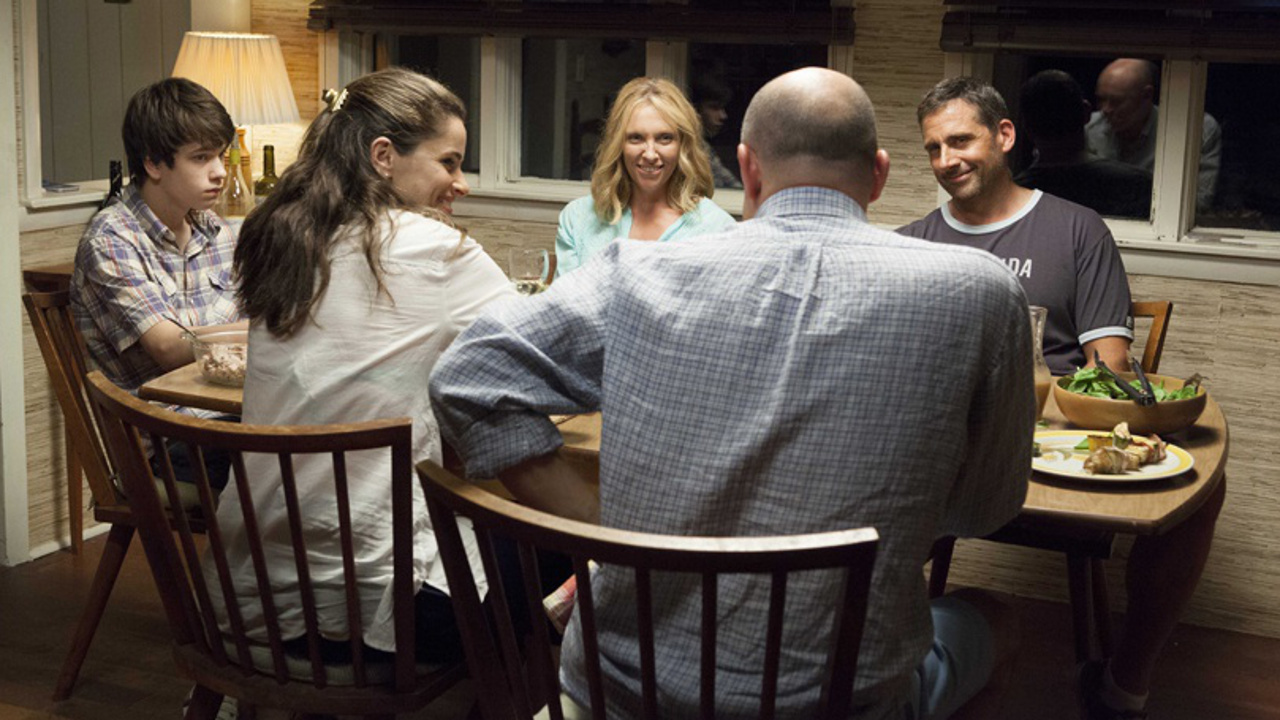
Liam James is 14-year-old Duncan, who is a model of teenage awkwardness; he carries himself like his arms and legs just sprouted the night before, and he isn’t quite sure what to do with them. He’s been dragged along to Cape Cod by his mother (Toni Collette) and her new boyfriend Trent Ramsey (Steve Carell). Carell plays pretty beautifully against type as a bullying, Type-A sort who is always on Duncan’s case, but able to say just the right things to his mom to keep her around. Honestly, Carell is more despicable in this movie than he is in “Despicable Me 2.”

The vacation is clearly a chance for the parents to get drunk and party on the beach with their friends (including Rob Corddry and Amanda Peet as neighbors, and Allison Janney as a boozy divorced mom) while their teenaged children seethe on the sidelines. Seriously, is there anything more horrifying for a teenager than to see their parents partying? “Way Back” captures that discomfort acutely.

waywayback2

Retreating into himself, Duncan explores the town and finds a water park called Water Wizz that has been immaculately preserved since it opened in — you guessed it — the 1980s. Owen, the loopy manager of the park (Sam Rockwell), takes Duncan under his Hawaiian-shirted wing, and offers him a job. At the park, Duncan makes his own set of friends (including Rash and Faxon, their faces familiar from their TV work on “Community” and “Ben & Kate,” respectively) and slowly gains confidence in himself.

“Way Back” is good-natured, and just true enough about the painful humiliations that can mark the teenage years, so that when Duncan’s inevitable triumphs come, they feel satisfyingly well-earned. Unlike the charmingly cute “nerds” of most teen movies, James’ Duncan is authentically dorky and off-putting at times, and he develops a warm chemistry with Rockwell’s zinger-dropping goofball that’s clearly patterned after the Bill Murray-Chris Makepeace relationship in “Meatballs.” Rockwell is just perfect as the layabout goofball who keeps a fatherly concern beneath the surface of his zinger-a-minute patter.

My only concern here is that the water parks at Wisconsin Dells will use “The Way, Way Back” to entice Slovakian kids to come work there during the summer. (Kids, it’s just a movie! Sam Rockwell isn’t really going to become your friend!)

“Somm”: Pouring your heart and soul into a glass of wine

somm6

Somm” screens Friday only at the Madison Museum of Contemporary Art. Unrated, 1:33, three stars out of four.

Do you love wine? Are you the sort of person who swishes the liquid in the glass, holds it up to the light, pronounces it to be redolent of “black currant, baking spices, and freshly opened tennis balls.” If so, then Jason Wise’s “Somm” is your kind of documentary.

But even if you buy your wines on clearance at Target, you might find yourself swept up in Jason Wise’s engaging film. Because it’s really more about guys who live and love wine, and their quest to be recognized among the elite wine experts of the world.

(UPDATE: I just learned Monday afternoon that the Madison Museum of Contemporary Art screening and wine tasting set for Friday has been cancelled. Bummer. “Somm” is still on iTunes to rent or buy, so uncork your own favorite wine and do a tasting at home, won’t you?)

Four young men are preparing to take the master sommelier test, a grueling three-part exam that only 200 people in the world have cleared. The first part is a general knowledge exam on wine and spirits, the second part is a service exam where the applicants have to role-play in a mock restaurant.

It’s the third part that’s the killer — a blind tasting of six wines, three red and three white, that could come from anywhere in the world. Years of knowledge, experience and developed senses all come together for these wine stewards in those few minutes.

No wonder it’s such an obsessive goal, one that causes the men to put aside their regular lives (including long-patient girlfriends and wives) to taste and taste again, preparing for the exam. Some of the tasting scenes confirm the stereotype of wine nerds as almost comically overwrought about wine; we see wine snobs take a swig and declare that it has notes of “Grandmother’s closet” and “freshly-cut garden hose.” (Who cuts a garden hose?)

But Wise’s film is as much about the type of personality that would commit themselves to this kind of quest, and the strain that such shared ambition can put on friendship. They’re not the effete, bloodless caricature we have of wine snobs, but driven, at times arrogant young men; you could just as easily imagine them training to become surgeons or trial lawyers as sommeliers.

SOMM3

Wise follows the four men in the last few weeks of preparation before the exam: the type-A Ian Cauble is a bundle of nerves going over index cards every waking moment, while the more laidback Brian McCorkle worries about the worst-case scenario — that all but one of the friends will pass, leaving the other behind.

The suspense builds effectively as the four men head to Dallas for the exam, and then — Wise’s cameras are prevented from going inside the exam. That’s a little frustrating, although the scenes of the men torturing themselves as they wait for the results, nervously comparing their choices in the blind tasting, almost make up for it. When the results do come in, some surprises are in store.

“Somm” is an enjoyable portrait of these men, as well as a sincere evocation of their deep appreciation for wine. As Cauble puts it eloquently at the start of the film, a tasting is one of those rare moments where he can experience life entirely through his senses. Although you can’t blame one guy when, at the height of his preparations, he dreams of going off on vacation — and having a beer.

“To the Wonder”: Looking for poetry in a Walmart parking lot

Redbud_Day16 (402 of 347).CR2

To the Wonder” has its free Madison premiere on Saturday, July 13 at 7 p.m. at the Union South Marquee Theatre, 1308 W. Dayton St., as part of the UW-Cinematheque’s tribute to Roger Ebert. R, 1:52, three and a half stars out of four.

Can you find poetry in a Sonic drive-thru? In 2011″s “Tree of Life,” Terrence Malick presented a rapturous portrait of childhood lost, every image of a 1950s boyhood in Texas so beautiful that you hated to see them fade.

Malick now gives a contemporary love story the same treatment in “To the Wonder,” a love story again told in visual poetry and half-heard whispers. I loved “Tree of Life,” but this time around, I was a harder sell. Does this romance deserve this kind of epic treatment, I wondered, or are we in the hands of a filmmaker so used to reaching for beauty that he sometimes can’t touch the humanity that’s right in front of him?

Neil (Ben Affleck) and Marina (Olga Kurylenko) are new lovers in Paris, rapt with each other and with the idea of each other. We see them cavorting in the park with Marina’s daughter Tatiana (Tatiana Chiline) and visit a Benedictine abbey built on sand. The sight of the tide coming in and sluicing through the tiny ripples in the sand is one of the most beautiful things I’ve seen on a movie screen.

But rapture can’t last. Neil invites Marina to come live with him back in suburban Oklahoma, a land of Wal-Marts and homes that look they were just taken out of the box, the empty landscape divided into high-fenced yards. Cinematographer Emmanuel Lubezki searches for poetry in this new world, just as Marina does, and they both occasionally find it. But Neil grows taciturn, perhaps worried that his twirling, girlish French lover doesn’t fit into the neatly-arranged boxes of his home life. Marina grows restless, passions cool, and Marina eventually takes her daughter back to France.

Back home, Neil connects with an old flame, Jane (Rachel McAdams), a rancher who seems to fit in perfectly in Neil’s life. But then Marina returns, seeking another chance, and a classic, tragic love triangle is played out against the empty, pitiless vista of an Oklahoma sky.

Faith has been a powerful theme running through Malick’s films, and here it takes the form of a Spanish priest (Javier Bardem), an expatriate like Marina, who tends his diminishing flock and privately nurses doubts about his faith. Parallels are drawn, between the imperfect love we feel for others and the mysterious love we feel from God. Can we make a necessary leap of faith in both our carnal and spiritual lives?

Redbud_Day12 (86 of 539).CR2

I will confess that I found myself watching “To The Wonder” on two parallel tracks. One was a state of snarky cynicism, that Malick’s attempts to take an ordinary relationship and inflate it to awe-inspiring heights was pretentious and almost laughable. As I said on Twitter, the one thing I learned from the film is that puddle-splashing and pasture-twirling are not a solid foundation on which to build a relationship.

But on the other track, I was buying in. The film’s flowing imagery and minimal dialogue induce a kind of meditative state, much like in “Tree of Life,” and when those images rhyme with the emotions beneath them, it was quite powerful. The shot of the doubting priest hiding in his house, as an impoverished parishioner pounds on his frosted-glass door, was a haunting image of shame, as unforgettable in its own way as those tide pools in France. So I found my higher and lower selves having different, simultaneous reactions to the film — and I couldn’t tell you for sure which was my higher self and which was the lower.

In the end, transcendence won out. “To the Wonder” is an imperfect film that perhaps reaches too high and too far, but I admire the effort, and am grateful for those moments when Malick does connect, and the film suddenly becomes glorious.

“Despicable Me 2”: Even a touch of evil would be nice

despicable-me-2_17

“Despicable Me 2” opens Wednesday at Point, Eastgate, Star Cinema, Cinema Cafe and Sundance. PG, 1:38, 2 1/2 stars out of four.

When I took my daughter, then 6, to see the original “Despicable Me” in 2010, she laughed at the joke about how the villainous Gru’s evil scientist henchman Dr. Nefario is hard of hearing, so when Gru asked him to design a dart gun, he instead created a fart gun. She laughed about this — she laughed during the closing credits, she laughed on our way out the theater, she laughed down the hall and into the lobby, she laughed out in the parking lot and into the car, and she laughed all the way home.

It would be too much to ask the sequel to hit that same comedic sweet spot for her, of course. And “Despicable Me 2” did make the kids laugh, although not as long and not as often. It’s an amiable, visually eye-popping animated movie that holds your interest, even as you sense that it’s not really taking advantage of the possibilities offered by the first movie. And the fart gun appears a couple more times, to increasingly diminishing returns.

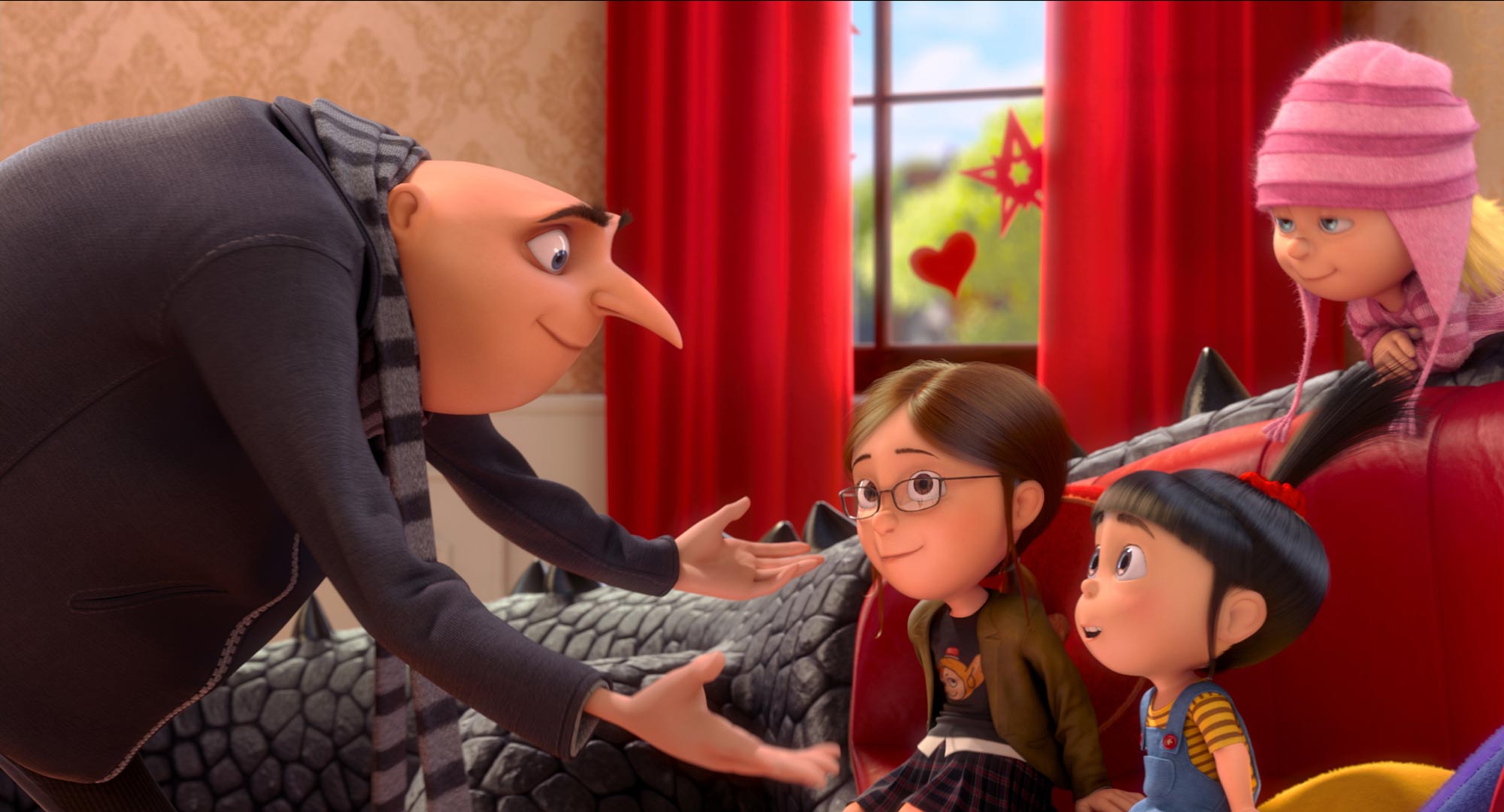
The delight of the first “Despicable Me” lay in its wicked premise: a Blofeld-like supervillain named Gru (Steve Carell) gets distracted from his evil plans by having to adopt three orphan girls, and finds himself ultimately tamed and charmed by them. It was genuinely sweet, but it also had a a naughty edge to it. The nefarious glee Gru took in both stealing the moon and popping a kid’s balloon animal was hard to resist.

In “Despicable Me,” that edge is mostly gone. Gru is now a happy single dad who dotes on his three girls, and converted his secret lair into a jelly-making franchise. He’s content, until secret agent Lucy (Kirsten Wiig) approaches him; the Anti-Villain League is trying to find another supervillain who hijacked a secret laboratory, and wants his help.

Gru reluctantly agrees to play hero, and goes undercover at the local mall, where the AVL are sure the supervillain is hiding. Is it the proprietor of the local Mexican restaurant (Benjamin Bratt)? Or is it the owner of the men’s wig store (Ken Jeong)? Or is it — actually, that’s all the suspects the screenplay bothers to come up with.

After the outlandish plots and visual gags of the first “Despicable Me,” going undercover at the mall is pretty underwhelming. And, more fatally, Gru as hero is just not as interesting as Gru as villain. I mean, it’s adorable how much he cares for the little tykes, and the tentative romance between him and Lucy is nice and all. But it would have been funnier to see an inkling of the old Gru peeking through, perhaps momentarily swayed by the idea of rejoining the dark side. He’s just so (shudder) nice.

The filmmakers seem to recognize that a tamed Gru isn’t that interesting, because a hefty chunk of the film focuses on his adorable, marketable Minions. (The next movie in the franchise won’t be “Despicable Me 3,” but a Minions movie.) Voiced in a kind of pidgin French by directors Pierre Coffin and Chris Renaud, the Minions are like an army of little yellow Stooges, and the film diverts its path several times to give them room to get some laughs. (They also figure into the villain’s dastardly scheme.)

The antics of the Minions are enough to keep kids and adults involved, as is the dazzling 3D, including a post-credits sequence where bubbles and butterflies float out convincingly over the audience. The kids will be happy with “Despicable Me,” the parents won’t mind.  But I couldn’t help wanting to see Gru haul out his old panda bearskin bug, just for old time’s sake.

“The Heat”: Melissa McCarthy can’t stop, won’t stop

the-heat

It turns out Melissa McCarthy is just as good in large doses as well. After her fantastic supporting turns in “Bridesmaids” (Oscar-nominated) and “This is 40,” I assumed that I didn’t want too much of a good thing from her profanity-riddled comic tirades.

But when “The Heat” ended after nearly two hours, I was secretly hoping for some outtakes during the credits, something along the lines of that beautifully homicidal aria she delivers in a post-credits “This is 40” outtake that just goes on and on, getting funnier and funnier. After two hours, I still hadn’t had enough. She’s that good.

And I didn’t really see it coming from the trailer for “The Heat,” which looked weak and wobbly. I don’t think trailers play to McCarthy’s strengths; they usually grab the biggest and loudest moments from her performance. In fact, she will take a bit up and down, pushing it farther and longer than you think it can possibly go — it’s the build-up that’s funny as much as the crescendo. (The “little girl balls” bit in her police chief’s office, which could have been a one-liner, but stretches and stretches out, is a prime example.)

“The Heat” doesn’t do a whole lot other than give a nice big canvas for McCarthy to work on, which I suspect is all director Paul Feig (who also did “Bridesmaids”) really wanted. There are some wry send-ups of the buddy cop genre; I liked how Tom Wilson’s police chief, who is usually an angry volcano in these movies, is instead quietly, sadly beaten down after prolonged exposure to McCarthy’s Shannon Mullins. (“My kids call me Grandpa.”)

And attention must be paid to Sandra Bullock, who I didn’t think would quite fit in an improvisation-minded R-rated comedy like this, but throws herself pretty fearlessly into her part. She tightens the screws an extra two or three turns on her tweaked FBI agent until she’s playing a knowing send-up of all those driven career women the movies keep giving us.

But the show is McCarthy’s, and everyone knows it. One of my favorite bits is that throwaway scene at the beginning where she wedges her car in between two squad cars, and she has to wriggle out her car window, into the squad car and out the opposite side. It’s a scene that showcases both her gifts at physical comedy (she’s surprisingly graceful — you try doing that) and verbal, and she unleashes an under-the-breath tirade of colorful profanity that’s a riot. Maybe McCarthy’s approach to comedy will get old, someday. But it feels like she’s just getting warmed up.