2012 Oscar live action shorts find the familiar all across the globe

curfew

“2012 Oscar Shorts — Live Action” opens Friday at Sundance Cinemas. Not rated, 1:47.

This year’s crop of five live-action short films take us from a retirement home in Quebec to a beach in Somalia, from a junkyard in Afghanistan to a bowling alley in New York.

Where several of the films struggle, however, is in finding something interesting or new to say once they get there. While the animated short nominees this year are uniformly strong, the live-action shorts this year play it awfully safe. In particular, in having seen a few years’ worth of these films, I’m getting awfully tired of films set in Third World countries — often made by Western filmmakers — that tell some sort of fable or parable, rather than an honest depiction of how life is lived there. It’s like the films want credit for bringing attention to this troubled regions, but want to tell a tidy, uplifting story that won’t turn off Western audiences.

For example, “Asad” has noble intentions, with a cast entirely made up of Somali refugees, telling the tale of a young boy, Asad, who daydreams about joining the pirates raiding luxury yachts off the coast, and is loathe to settle for the simple, unglamorous life of a fisherman. The boy who plays Asad is very affecting, but the story is weak, and the twist ending involving Asad’s mysterious “catch” from visiting a boat raided by pirates is just weird, and in rather poor taste.

Much better is “Buzkashi Boys,” a gritty and cinematic look at two boys living in Kabul, Afghanistan. One boy is shy, quietly chafing at the prospect of becoming a blacksmith like his father, while his brash friend daydreams of playing buzkashi, a brutal sport that’s sort of like polo, but with a dead goat as the ball. The film has a striking, even terrifying beauty as it uses the bombed-out locations of Kabul, in particular a junkyard full of buses, stacked high on top of each other, that seems like something out of a nightmare.

Standing out from the pack is the Belgian steampunk thriller “Death of a Shadow,” in which a time-traveling photographer (Matthieu Schoenarts of “Rust and Bone”) is dispatched with a special camera that can capture a person’s shadow at the moment of their death. He brings these shadows back to a creepy collector, who sticks the shadows to the canvas like a lepidopterist pinning butterflies. It’s an idea rich with haunting possibilities, and unfortunately the film seems to rush ahead rather than pausing to explore them a little more.

The French-Canadian “Henry” is a rather wan attempt at trying to get inside the mind of a patient with dementia, using cheap cinematic tricks in the vein of a paranoid thriller to try to make us guess what’s real and what isn’t. Movies like “Away With Her” and “Amour” have explored the same territory with more feeling.

Finally, Shawn Christensen wrote, directed, edited and stars in “Curfew,” playing a suicidal artist whose humanity is awakened after he babysits his niece for a night. Christensen is a talent behind the camera, and the film is full of lyrical touches, like a surreal dance number at a bowling alley. But the screenplay is a thinly-conceived redemption story, with cookie-cutter characters, and the film ends up not earning the emotional uplift it’s stretching for.

2012 Documentary Short Oscar nominees pack a dramatic punch

Inocente_4_IMG_7786

“2012 Oscar Shorts — Documentary” opens at Sundance Cinemas in Madison Friday and plays only through Sunday. Not rated; 3:15 (divided into two programs).

Sometimes, nothing grabs you by the lapels like a real person, looking into the camera, and telling their story.

The five nominees for an Oscar this year for Best Documentary Short all deal with weighty issues — homelessness, illness, old age. But they all do so on a very human level, eye to eye with the viewer. With each film running exactly 39 minutes — the ideal length of time for a documentary to run on HBO or public television, the likely home of all these films — watching all five of them in a theater isn’t exactly casual viewing. But it is worthwhile.

The best of the bunch for me is the luminous “Inocente,” telling the inspiring story of a 15-year-old homeless Latina girl, and how she uses her art — paintings as vibrant and hopeful as her life can be bleak and despairing — to overcome her circumstances. The film by Sean Fine and Andrea Nix (“War/Dance”) adeptly pulls in many threads, from larger issues involving child homelessness to Inocente’s contentious relationship with her mother. But the film is riveting when Inocente, her face often painted with elaborate markings, locks eyes with the camera and fearlessly tells her story.

Also very affecting and intimate is “Mondays at Racine,” Cynthia Wade’s film about a Long Island hair salon who, on the third day of each month, offers free services each month to cancer patients. We meet a range of women dealing with cancer, from Linda, a 60-year-old woman who has seen 18 years of cancer destroy her marriage, to Cambria, a young mother terrified of leaving her children behind. It’s the little things that can matter, and in the end, I suppose getting dolled up for a day is small comfort for these women. But you can see the effect that such a loving act can have, as when Linda fits the perfect wig on her bald head and says, “I’m alive.”

Kings Point” is an unexpectedly complex film from Sari Gilman about the residents of a Florida retirement community. The film is neither cutesy nor sentimental, but a revealing and sometimes tough-minded look at these elderly people (many widows or widowers) who have chosen to spend their last years far from their families, surrounded by acquaintances but few real friends. It’s the good life they spent a lifetime yearning for, but what, in the end, does that really say about that lifetime?

Open Heart” is a simple but powerful film about Rwandan children with heart disease who undergo a high-risk surgery. As well as telling the story of these brave children in their families, the film shows the difficulties of trying to conduct high-risk, advanced surgery in an African nation where millions need medical attention. Finally, “Redemption” is an insightful and sometimes wry look at several New York City residents who make their living collecting and recycling cans off the street. “This is full-time work,” one says, and after spending time with them in this fly-on-the-wall film, you believe it.

“Citizen Koch” and “56 Up” coming to Wisconsin Film Festival

56-up

I wrote a story for the Capital Times yesterday with an update on some of the titles that have been announced for the Wisconsin Film Festival, which runs April 11 to 18. I think if there’s any trepidation among longtime fans about the big changes afoot at the festival (a change in leadership, and the fact that the festival won’t be downtown this year, screening on campus and at Sundance Cinemas), hearing the movies that are coming will go a long way towards easing their worries.

So far, it sounds like a great festival. The two big titles with the biggest local connections are “Citizen Koch,” the documentary about the Citizens United decision’s effect on the nation, focusing specifically on Gov. Scott Walker’s attempt to strip most public unions of most of their bargaining rights, and the resulting protests in early 2011. It was kind of a no-brainer that “Koch,” which premiered at the Sundance Film Festival last month, would make it to Madison.

Less of a sure thing was “56 Up,” the latest in Michael Apted’s landmark documentary series interviewing a group of people every seven years of their lives. One of the participants is Nick Hitchon, who is a professor at the UW. I don’t believe “49 Up” played theatrically in Madison, so it’s gratifying to see the new version (which got a great review in the New Yorker last month) will make it here.

In past years, the Wisconsin Film Festival titles were usually announced in one fell swoop in early March, but festival organizers have been releasing names in dribs and drabs via social media over the last few weeks. Since I wrote the Capital Times story, for example, the festival announced via Facebook that it would be showing a film about Bill Watterson, the creator of “Calvin and Hobbes.”

“Starlet”: Have you heard the one about the octogenarian and the porn star?

starlet

It sounds like the worst sitcom on Lifetime: a beautiful young porn actress befriends a cranky old lady with a bingo addiction.

And yet Sean Baker’s “Starlet” works hard to avoid any sort of cliche, or any audience expectations at all, really. Instead, it’s an unsentimental yet moving indie drama that keeps allowing its two main characters to reveal deeper and deeper layers beneath their easily stereotyped facades. It’s exactly the sort of well-crafted low-budget indie that Madison needs to see more of in theaters, so audiences shouldn’t miss the chance. “Starlet” screens for free in the Union South Marquee Theater, 1308 W. Dayton St., at 7 p.m. Thursday and Saturday.

Dree Hemingway (daughter of Mariel and great-granddaughter of Ernest) makes an assured lead performance as Jane, a languid 22-year-old Florida transplant who bides her time in California’s San Fernando Valley, a sun-dried wasteland of cheap apartments and strip malls. Dree and her two deadbeat roommates (Stella Maeve and James Ransone) dabble in porn to pay the rent. Dree seems smarter than her roommates, less desperate and deluded about her circumstances, but one of the fascinating aspects of “Starlet” is discovering how much of her worldliness is real and how much is just a pose. Hemingway’s nuanced (and often funny) performance keeps us wondering.

Jane’s moral compass is put to the test when, at a yard sale, she buys a thermos for a dollar, takes it home and finds that it’s filled with tightly-wrapped wads of cash. She immediately goes on a shopping spree, but then, out of a sense of guilt or just curiosity, starts visiting the 85-year-old Sadie (Besedka Johnson) she bought the thermos from. Sadie is hilariously crotchety and resistant, but Jane is so doggedly, cheerfully persistent that Sadie finally starts to warm up to her.

Their friendship goes nowhere you might expect — Sadie doesn’t teach Jane any hard-won life lessons, and Jane doesn’t try to rekindle Sadie’s lost youth. There are no montages here. Instead, Baker shows how their completely different worlds slowly find an intersection point, tentatively. I love how Johnson (in her first acting role) never makes Sadie the least bit likable; she’s a genuinely prickly and difficult woman to the end, and yet makes us feel for her deeply.

Baker opts for a very naturalistic style in the vein of Kelly Reichardt (“Old Joy”) or Kenneth Lonergan (“You Can Count on Me”), allowing scenes some space for awkward pauses and meaningful glances, for the hesitations and awkwardness of real interactions. He has one favorite technique he employs several times, letting the twinkling music on the soundtrack build and build, and then suddenly shutting it off cold.

The film features some explicit sex in its portrayal of the adult film industry, but what’s more shocking than the nudity is how incredibly boring porn looks for all involved. Baker lets the film spend a little too much time in this world, especially following the hapless exploits of Dree’s roommates, who, incredibly, seem too dumb even for porn. I kept wanting to get back to Jane and Sadie, how Jane grins wickedly as she prods and pokes Sadie into some kind of response, and how Sadie, after a withering flicker of her eyes, finally allows herself to light up a little.

See all nine Best Picture nominees in 36 hours and get really, really depressed

Les-Mis-Hathaway-Jackman11-1280x844

I had mentioned on Monday that AMC Star Cinema was offering moviegoers the chance to see all nine Oscar contenders for Best Picture in one fell swoop — four of them on Saturday, Feb. 16 and the remaining five on Saturday, Feb. 23.

Wimps.

Now Marcus Theatres announced Tuesday that they’ll be showing all nine films in one weekend at several of its theaters, including Point in Madison. You can see the first five films on Saturday for $30, and the remaining four films on Sunday for $25. Or you can shoot the moon and see all nine films for $50. Visit marcustheatres.com to buy tickets.

I don’t think there’s any question this is a great deal, both financially and artistically — the crop of Best Picture contenders is awfully strong this year. The one I like the least is “Les Miserables,” and I still pretty much liked that.

No, the question I have is more medical in nature: Should the human brain be subjected to that much misery in such a concentrated amount of time?

Oscar contenders frequently get knocked for being a pretty sad bunch of films, but this year’s crop seems particularly dire. Let’s walk through Point’s film-by-film schedule and see what we’re in for, shall we?

Saturday

11 a.m. — “Beasts of the Southern Wild” (global warming, loss of home, death of parents)

1:10 p.m. — “Amour” (dementia, illness, slow and painful death)

3:40 p.m. — “Les Miserables” (poverty, war, sickness, forced prostitution, economic injustice, and, of course, lots of death)

6:50 p.m. — “Argo” (kidnapping, terror)

9:20 p.m. — “Django Unchained” (slavery, torture, and bloody, bloody death)

Sunday

12:30 p.m. — “Life of Pi” (shipwreck, death of parents, starvation)

3:10 p.m. — “Lincoln” (war, slavery, and — spoiler alert — death)

6:10 p.m. — “Silver Linings Playbook” (mental illness, death of spouse, ballroom dancing — this is the romantic comedy)

8:50 p.m. — “Zero Dark Thirty” (terrorism, torture, death of innocents, nagging sense that the moral cost of conquering our enemies may not be worth it)

Now, I’m not saying don’t go see these movies. I’ve seen all nine of them and are much better for it. All I’m saying is that they can get a little grim. Might want to DVR a few cartoons and episodes of “Parks and Rec” to perk yourself up afterwards.

Point’s big remake includes full-service bar and marquee

pointbuilding

To paraphrase Tom Waits, so that’s what they’re building in there.

Point Cinemas patrons, especially the early birds who have been chagrinned lately to see the west side theater not open until 3 p.m. during the week, have been wondering what Marcus Theatre has had in mind with its renovations going on over there.

Well, the company officially announced its renovation plans for the theater, and the one not surprisingly getting the most attention is the addition of a full-service bar, the Take Five Lounge, offering beer, wine and cocktails, as well as appetizers and Milwaukee-based Zaffiro’s pizza, from 11 a.m. to midnight daily. According to Wisconsin State Journal reporter Karen Rivedal, who broke the story late Monday, the theater will file an application for a Class B liquor license at Tuesday night’s Madison City Council meeting, from which it will be kicked to the Alcohol License Review Committee.

As I read the press release Marcus sent out late Monday afternoon, the theater is not asking to allow patrons to bring beer or wine outside of the lounge and into theaters, something you can do at Sundance Cinemas. The challenge for the theater will be making sure no overserved customers make a nuisance of themselves during screenings. I’ve never run into that as an issue at Sundance, but part of that may be that Sundance has many patrons for its second-floor bar (and especially the Rooftop Bar in the summertime) who never even go to a movie. Point’s location isn’t as friendly to the after-work-drinks clientele, so I’m guessing the vast majority of folks who drink there also plan on seeing a movie either before or after.

What this means, I think, is that Marcus has been paying attention to the success that theaters around the country have had in integrating alcohol and food sales into the moviegoing series, to get folks to arrive early to eat and stay later for a post-show chat over drinks. The challenge, I think, is making that work in a space as isolated as a suburban multiplex — most of the ones I’ve seen work in other cities tend to be in urban areas, or within walkable shopping areas or other mixed-use developments where it’s a little more natural for people to kind of move in and out.

Among the other renovaitons, Point will now have a giant tower marquee sign, similar to the one at Brookfield’s Majestic Cinema that you can see off Interstate 94 when you head into Milwaukee. Point was in dire need of a facelift, and losing the ’90s Santa Fe shopping mall exterior for something more classic (and classy) will be a welcome change. The Brookfield Majestic sounds like it will be a blueprint for the interior renovations that Marcus has in mind for Point, including an expanded lobby, recliming seats in the auditorums (except for the Ultrascreen) and a bigger box office.

Marcus plans to have all these renovations in place by May, just in time for the summer blockbuster season to kick off with “Iron Man 3” on May 4.

Maybe a date-night promotion connected to “Amour” isn’t the greatest idea

amour02

Movie theaters and studios are an interesting place right now. With less than three weeks to go until the Oscars, suddenly there’s a lot of interest from audiences in some very good films.

Which is great to see packed houses for “Zero Dark Thirty” or “Silver Linings Playbook.” But theaters don’t live on ticket sales alone — they need to move concession sales as well. The problem is that Oscar-nominated films tend to be downers, or at least about weighty subjects, so they don’t lend themselves to special tie-ins. Nobody wants a “Lincoln” commemorative cup to take home with them the way kids wanted a “Wreck-It Ralph” cup.

So I feel for whatever advertising executive at AMC Theateres thought this up.

First of all, this year AMC is continuing its tradition of having marathon showings of all the Oscar-nominated films at its theaters nationwide. Which is a fun idea — it’s a great chance for film fans who have had other priorities over the holidays to get caught up in a hurry for their office Oscar pools. In Madison, on Saturday, Feb. 16 at 10 a.m., for $30, you can settle in and watch “Amour,” “Les Miserables,” “Argo” and “Django Unchained,” then come back the following Saturday, Feb. 23, at 10 a.m. and spend $40 to watch “Beasts of the Southern Wild,” “Life of Pi,” “Lincoln,” “Silver Linings Playbook” and “Zero Dark Thirty.”

So that’s great. But then AMC took it a step further with their “Oscar Offer Mania” promotion, in which they tied special discounts to each movie. See “Argo” today through Wednesday and get a free small drink. Fine. Free small cheese pizza “pie” when you see “Life of Pi.” Cute.

Then we get to “Amour,” the incredibly sad French film about an elderly man watching his lifelong wife slip into illness, dementia and death. Which at AMC, you can watch with a a free Light Snacker popcorn and soda combo!

This is the actual ad copy with that offer:

“Celebrate a love that spans generations and share a popcorn and soda combo with someone you love.”

Wow. Sounds like a great date-night outing! Say, in the spirit of the movie, should I hand-feed my date the popcorn and spoon soda into her mouth while we watch?

I suppose it could be worse. The promotion connected to “Zero Dark Thirty” could have been “Waterboard yourself with our jumbo-sized soft drinks, now $1 off!”

“Amour”: A lifelong love faces its final test

Amour

Michael Haneke’s “Amour” opens with some police officers breaking into a locked Parisian apartment. They find one door sealed with duct tape. Unsealing the door, they enter a bedroom and find an old woman, Anne, (Emmanuelle Riva) lying dead on her bed, surrounded by flowers.

That might seem like a spoiler, but it is the first scene of the movie. And, really, the entire movie is a spoiler, the most massive spoiler of all time. This is our ending. We’re all going to die someday, and many of us will die badly.

Haneke subtly reinforces the universality of his beautifully sad story by next taking us back in time a few months to a concert hall full of people. We have a hard time picking out the woman and her husband Georges (Jean-Louis Trintignant) from the crowd. They could be anybody.

In the cab ride home, we get a sense of them — retired music teachers in their 80s, cultured, still in love, still full of things to say to one another. They’re living the last years of their lives in the way all of us would — together, and loved.

Then they enter the apartment, and never leave it again for the rest of the movie. Anne suffers a stroke, goes blank for a few minutes. Then she comes back to Georges, as if nothing as happened.

But this is the beginning of the end, a long, agonizing slow fall rung by rung down the ladder, slipping away from Georges. Anne’s mental lapses become more frequent, and her physical health starts to deteriorate. She hangs on to the things that give her pleasure — books, music, conversation — as long as she can, but then that fades. She continues to slip away.

Through it all, Georges is single-minded in his devotion to his wife, refusing to put her in a retirement home or a hospice. He does everything for her — everything — and anyone who has had to take care of a terminally ill loved one will feel the pain of recognition. It’s not just the physical chores that must be done day after day — it’s the gulf that widens between caregiver and patient. When Anne cries out “Hurts! Hurts!” over and over, she can’t tell him what is wrong, and he can’t figure it out.

“Amour” has been nominated for five Oscars, including Best Picture and Best Actress for Riva, but not Best Actor for Trintignant. That says a lot about how we view acting. Riva’s performance is undeniably magnificent, as she must chart every step of Anne’s physical and mental deteriorating with exacting precision.

It’s an external performance, but Trintignant gives an internal performance that’s just as worthy. He’s incredibly loving towards his wife, but his single-minded devotion shuts out the rest of the world, even their daughter (Isabelle Huppert) when she comes to visit. He’s frustrated and abrasive, choosing to bear the entire burden himself; describing what his wife’s life as an invalid is like to his daughter, he says, “None of all that deserves to be seen.”

But, of course, Haneke is showing us all of it, sparing us almost nothing. In the past, I’ve always thought Haneke made films to torment and his audience; “Cache” offered us a brilliant Hitchcockian thriller, but only if we were willing to be complicit in the actions of the unseen voyeur, and the sadistic “Funny Games” seemed to be a rebuke to anyone who buy a ticket to see a movie like “Funny Games.”

There’s definitely an element of that here, as we are shut into this apartment with Georges and Anne, sharing every bit of their misery with them. But it’s only by enduring that that we can understand what a great love story “Amour” really is, how everything Georges does for Anne — even the last thing — is done out of love.

Haneke wants his audience to face an uncomfortable truth about life, as he so often does. But this time, I think he means to celebrate how, if love can’t halt the inexorable march of time, it can make it a little easier to bear.

“Amour” starts today at Sundance. PG-13 for brief nudity and language; 2:07.

“Stand Up Guys”: Step back and let the old guys do their thing

Stand-Up-Guys_085051

There are those actors who you’d watch in just about anything. They’re the ones who just seem to enjoy themselves while they’re acting, whether the movie around them is bad or not.

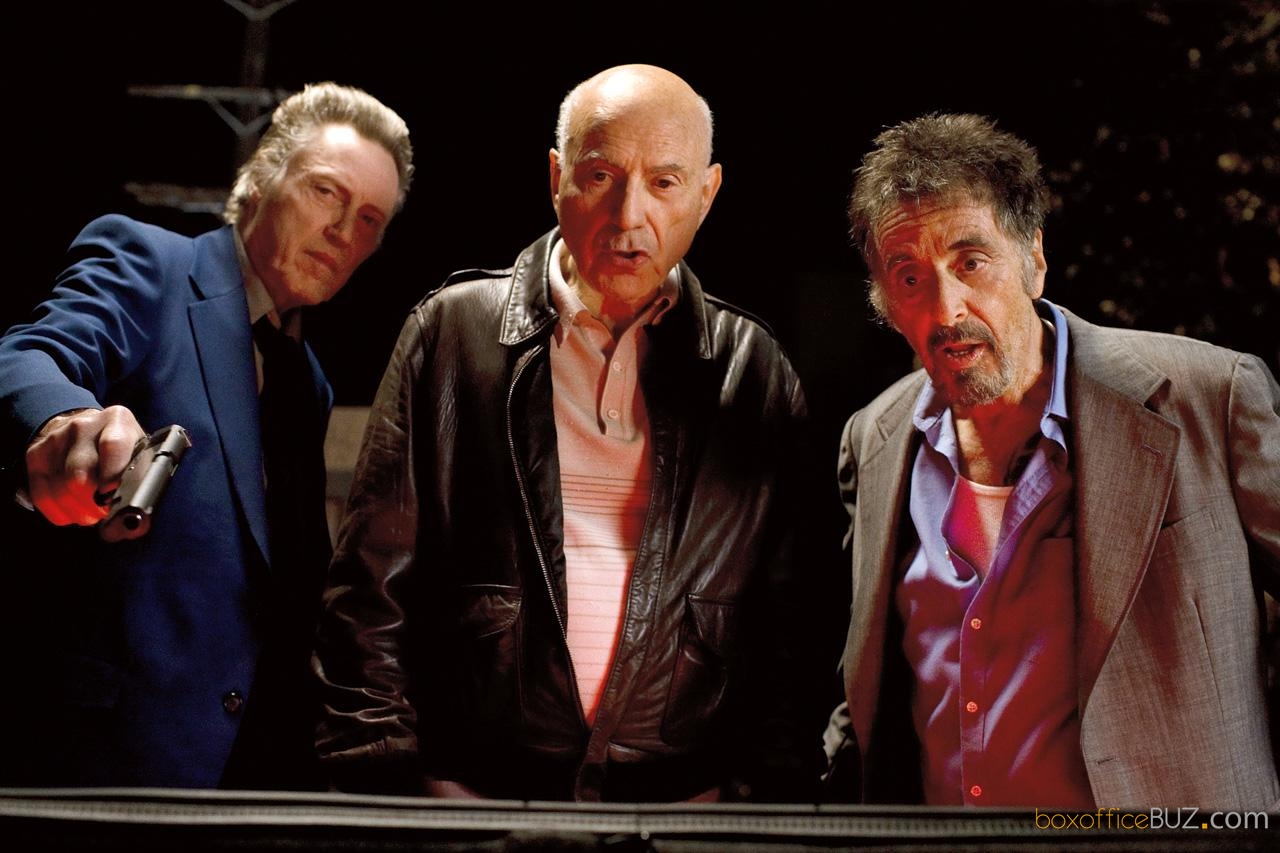
“Stand Up Guys” has three of them — Al Pacino, Christopher Walken and Alan Arkin — and just their presence goes a long way towards making “Stand Up Guys” a watchable movie. The movie itself doesn’t take it much farther, a sometimes ungainly mix of soft-boiled crime thriller and Viagra comedy.

But I enjoyed it well enough for the chance to see three old pros do their thing. “We’re all still here!” Pacino exults at one point, and their presence and vitality as performers is something to celebrate.

Val (Pacino) is a small-time criminal who has just gotten out of prison after a 28-year stint for murder and bank robbery. Meeting him at the prison gates is Doc (Christopher Walken), his old friend, who promises him a first day of freedom to remember. But if Doc is so happy to see Val, why does he have such haunted eyes, and a loaded gun?

“Stand Up Guys” is thin on plot, although I kind of wish the film had jettisoned the plot altogether and just had 90 minutes of the actors sitting around diners shooting the breeze. Instead, the movie labors through some wheezy setpieces, such as the old guys going to a brothel and showing the women there a thing or two, or stealing a new Dodge Challenger, mystified at the keyless ignition. The best part comes when Doc and Val bust their old getaway driver Hirsch (Arkin) out of a retirement home for some fun; Arkin’s presence adds a lot of zip to the film, but despite his equal status on the movie poster, he’s really just in the film for an extended cameo.

The pleasure of the movie comes in just watching the veteran actors volley lines back and forth, taking about past glories and present-day regrets. Pacino is his usual florid, outsized self, serving up raspy f-bombs like slices of prime rib. Walken is more contained and still, delivering serious lines as if they were funny and funny lines as if they were serious. They make a good odd-couple team, and if actor-turned-director Fisher Stevens pushes the geriatric comedy too hard at times, at others he’s wise to lay back and let the actors just work.

The film ends with a deeply dumb shootout — Stevens must have mistakenly thought that the audience, so used to seeing these guys play gangsters, wanted to see then back in action. But it’s when Pacino and Walken are back in inaction, chatting over surf ‘n’ turf or walking the streets telling old gangster stories, that “Stand Up Guys” lives up to the joy they so evidently still take in their work.

“Stand Up Guys” is now playing at Point and Star Cinema in Madison. R for language, violence, and sexuality.

“Warm Bodies”: She loves me, she loves me rot

Warm_Bodies_3

Before he met her, he felt dead inside. Dead outside, too. And after he met her, he still felt dead. But he was in love.

That’s the wry premise behind the horror-comedy “Warm Bodies,” which goes light on the horror and heavy on the comedy. R (Nicholas Hoult) seems in some way like any awkward teen — uncomfortable in his own body, eager to connect with other people but unsure how. The catch is that that body is rotting away — R is a zombie, and keeps a running voiceover monologue of his woes in the film’s clever early scenes. “What’s wrong with me?” he bemoans. “I should eat better.”

While the humans are safely esconced inside a walled city, the zombies roam morosely around the local airport, perhaps because that was the place they felt the least human while they were alive, so it’s the place they feel the most human while they were dead? R’s days are spent grunting at the airport bar with his best friend M (Rob Corddry) and staying clear of another breed of zombies, the skeletal Boneys, who have ripped away their last vestiges of humanity.

On a mission to find some food (i.e. us), R stumbles across a band of humans, including Julie (Teresa Palmer), with whom he’s instantly smitten. He gets close to her the only way he knows how — by kidnapping her, and by eating her boyfriend’s brains, which contain all his memories of her. Not exactly a “meet-cute,” but writer-director Jonathan Levine (“50/50”) is sly about finding all the laughs in the idea of a human-zombie teen romance while still making it seem sweet and faintly believable.

By the way, if the names R and Julie don’t tip you off as to Levine’s source material for his tale of ill-fated lovers, perhaps the balcony scene will. Like the Montagues and the Capulets, both M and Julie’s father Grigio (John Malkovich) loathe the opposite side of the dead-undead line. And R and Julie have to overcome the prejudices of both their kinds to stay together, especially when they learn that the blush of romantic love might be enough to reverse the zombie apocalypse.

The film barely earns its R rating, and horror fans might be disappointed that “Warm Bodies” is almost gore-free; you see much worse every week on “The Walking Dead.” On the other hand, “Twilight” fans looking for the next supernatural teen romance might be bummed out that the film’s romantic hero, although a cutie, has rotting flesh and a little brain matter caught between his teeth.

But for the rest of us, “Warm Bodies” hits an appealing sweet spot, sending up what we know about zombie movies while still being awfully sweet, with Hoult’s halting zombie and Palmer’s jaded human making for a very likable couple. This is a quirky, fun film that lives for moments when Corddry, trying to console R after a romantic setback, shakes his decaying head and grunts, “Bitches, man.”

“Warm Bodies” opens today at Point, Eastgate and Star Cinemas in Madison. R for violence and language, 1:37.