Would I have been better off never seeing “Before Midnight”?

ethan-hawke-julie-delpy-before-midnight1

This isn’t a question of whether I think “Before Midnight” is a good movie or not, or whether I “liked” it in any traditional sense. I think Richard Linklater’s third film featuring Julie Delpy and Ethan Hawke as loquacious paramours Jesse and Celine is a great film.

The question I have is more fundamental, on a level more basic than that of a film critic: Would I have been better off never seeing “Before Midnight”?

The first two films in the series were literate and romantic movies with the most memorable unresolved endings in movies. In 1995’s “Before Sunrise,” we followed twentysomethings Jesse and Celine as they met on a train in Vienna, decided to spend the day together on a whim, and had a 24-hour love affair with more depth and passion than most long-term romances. They parted at the end of the film, promising to meet back at the same spot in 6 months, and we left the theater figuring we’d never find out if they made that date. But hoping they would.

In 2004’s “Before Sunset,” the pair meet up in Paris in their early 30s. Celine has come to Jesse’s book signing, and the pair walk around Paris, talking about their lives, the roads taken and not taken. Both are unhappy, both feel that connection rekindling. The movie ends in Celine’s apartment, Celine charming the socks off Jesse, Jesse about to miss his flight back to his wife and son. We don’t know if they actually get together. But hope they would.

So, should we have left it there? By “Before Sunset, I and a lot of other fans became deeply invested in the love story of Jesse and Celine, in the notion that a connection that can change your life could always be just around the corner. Sure, there’s an element of romantic fantasy to that, but is that so bad?

In 2013, now comes “Before Midnight,” which definitively answers the question posed at the end of “Before Sunset.” Yes, they did get together. They didn’t get married, but Jesse left his wife, moved to Paris, and the couple had twin girls. In the first five minutes of “Midnight,” it looks like the best possible outcome of the options floating in our minds at the end of “Sunset.”

Except Linklater, Delpy and Hawke have something different in mind for “Midnight,” something of a bait-and-switch for fans of the series. The first hour of the movie is still based heavily on conversation, on long takes of Jesse and Celine talking about their lives to each other. (Although, they hardly ever talk about their daughters, which is so strange as to be significant.) But the similarity to the first two movies is deceptive — you notice that the conversation is a little more strained than before, with an undercurrent of sourness and disagreement. Jesse has to work harder to charm Celine, using silly voices or ironic come-ons. The film even makes clear that this is the first time in a while they’ve had lengthy conversations like this. Celine resents that she had to downshift her career when the girls were born, and it sets her off when Jesse raises the possibility of moving to Chicago to be nearer his son.

And then the film takes all the romantic projection and goodwill built up over two-and-a-half movies and sandbags us with the last half hour, which is an on-screen marital fight as brutal and unrelenting as we’ve seen. All the tensions simmering during the film come boiling up to the surface, and we see the most unpleasant sides of Jesse and Celine on full display.

It’s just awful to watch, like watching your parents fight. We learn things about the couple we never wanted to know. After giving us such a romantic, lofty view of life in the first two movies, “Midnight” brings us crashing down to earth. Love is hard, and just gets harder over time, the movie tells us. The dream can’t last.

I think it’s the final scene, the supposed reconciliation between the two on the dock, that’s even harder on the notion of romantic idealism. Jesse wins over a begrudging Celine, at least temporarily, with a goofy story about being a time traveler from the future, telling her that they’ll get past this and everything will be fine someday. It’s a perfect bookend to the time-travel tale he told her on the train at the beginning of the first movie. Then, it seemed like a clever way to think about fate and chance.

Now, it just seems like a tired, desperate parlor trick, and Celine doesn’t so much play along as give in, because it’s easier than to resist. “Midnight” ends on an unresolved note as well. Only this time, instead of giving us a “maybe,” it gives us “maybe not.”

I think it’s going to take me a while to sort out my feelings about that. On the one hand, it’s a gutsy turn for the series to take, and it definitely has an impact. On the other hand, I don’t think I’m ready to embrace the cynicism of that turn, showing us that even one of Generation X’s great movie love affairs has to fall back to earth sometime.

It’s a great movie, to be sure, one I still think about weeks later. But part of me wishes we could have left it back in that Paris apartment in 2004, Delpy channeling Nina Simone while an enchanted Hawke watches, and all possibilities lay before them.
AMC Theatres launches RunPee, for those who need their phone to tell them when to use the bathroom

largesoda

Now I’ve seen everything. AMC Theatres sent out a press release Monday touting its updated app, and along with the expected bells and whistles, such as linking it to their AMC Stubs rewards account was something called RunPee.

Horrible name. Revolutionary concept?

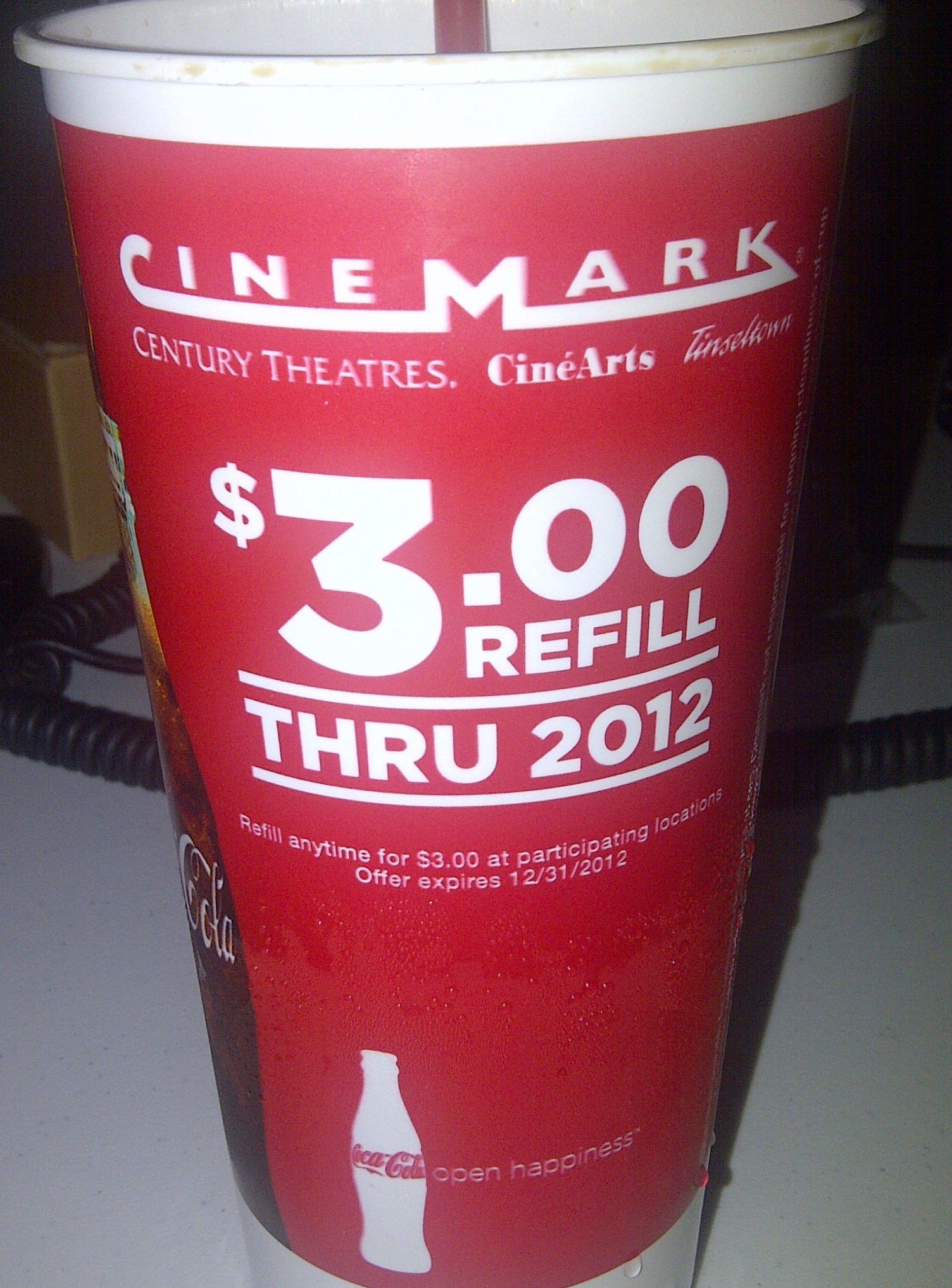
The premise behind RunPee, which began as a website (RunPee.com) and then a 99-cent app of its own before being folded into AMC’s, is that everybody needs to go to the bathroom at some point during a movie. (This may be the final stake in Mayor Bloomberg’s war against oversized sodas, as the populace adapts to consuming gallons of carbonated fluid rather than cutting back.) But nobody wants to miss three or four minutes in the middle of the movie.

So the original RunPee app would vibrate at a certain point midway through the film. It gives you a four-minute window to go to the bathroom (your mileage may vary) and then gives you a summary of those four minutes of plot. The AMC version doesn’t vibrate — it just tells you when to go and what you missed. This is something grown men and women are supposed to need.

For example, for “World War Z,” RunPee gives you three options of when to flee for the restroom. At 49 minutes in, your cue to leave is when Mireille Enos says “Gerry, I tried to call you.”  Go relieve yourself, and the app tells you that you missed the part where Gerry lands in Jerusalem and learns the Israelis have used giant walls to keep out the zombies. (Which seems kind of important to me, but whatever. RunPee seems more concerned that you don’t miss an action sequence than any actual plot.)

RunPee, in other words, is for that small subset of moviegoers who apparently check their phone regularly during the movie and yet can’t bear the thought of missing two minutes of a movie. And if AMC is officially sanctioning this, can we do away with the pre-screening admonishments about talking and using cell phones in the theater? It seems like letting your phone tell you when to go to the bathroom during a movie starts us down a slippery slope indeed.

Also, I couldn’t help noting that while “World War Z” offers three RunPee moments, “Monsters University” offers only one, which leads me to think the RunPee people have never seen a movie with a child. I would need RunPee options every five minutes if I had a kid in tow, just in case. Also, RunPee doesn’t seem to solve the problem of somebody in your row barging past you in the middle of the movie to go to the bathroom. Maybe RunPee 2.0 could sync up the phones in a given row so that everybody goes at the same time.

It seems like a silly concept to me, but AMC must like it enough to include it in their new app. Another, simpler option might be to simply go before the movie starts, or else not consume a beverage that’s the weight of a small child during the film. But how much fun is that?

Writing about “Gideon’s Army” and “Much Ado About Nothing”

amyacker

I’ve done some movie-related writing lately over at the Capital Times, so I thought I’d link to a couple of articles, plus a recent podcast I was on. Expanding the boundaries of the blog or shameless self-promotion — you be the judge.

First, I learned that “Much Ado About Nothing” star Amy Acker and co-star Emma Bates don’t just have Shakespeare in their bones — they have Wisconsin, too. Bates studied theater at the University of Wisconsin-Milwaukee, and in 1999 both of them spent the summer at Spring Green’s American Players Theatre, including appearing together in a production of — wait for it — “Much Ado About Nothing”! I couldn’t find Bates’ role in the press clips, but Acker, who had just graduated from college, played young ingénue Hero. The movie is now playing at Sundance.

Second, the most-read story on the captimes.com last week was a story I wrote back in April on a Wisconsin Film Festival screening of the documentary, “Gideon’s Army,” a terrific film that looks at the battles of three public defenders in the South. It premieres on HBO on July 2, but that’s not why it got the most traffic. For that, thank the good folks at Reddit, after user PennilessGent mentioned a detail from the story, that one of the public defenders has the names of the defendants of every case he ever lost in court tattooed on his back. Thanks, Reddit!

Also, I wanted to make sure to link from the blog to the recent Madison Arts Extract podcast I appeared on last week. It was a great half-hour chat between Mark Riechers, Ben Munson and myself. The first segment covers the UW-Cinematheque’s Roger Ebert tribute series that starts July 12, while the second was a freewheeling discussion about how to build a local film culture when so many people are streaming movies online rather than seeing them at their local theater. It’s also the last podcast Riechers hosted before moving to Chicago, so I felt honored to be a part of it.

Sundance Classics goes back to the ’50s (through the ’70s and ’80s)

grease

Last Wednesday, I had to beg, borrow and steal to get myself a seat to the sold-out screening of “Raiders of the Lost Ark” at Sundance Cinemas. I should have known to get to the theater earlier — that series routinely packs the theater on Wednesday nights. “E.T.,” which screens today at the theater, should be no exception. Even if you know the movie by heart (as I do with “Raiders”), it’s still so much fun to see it on a big screen with a big crowd. (Everybody still laughed when Indy shot the swordsman.)

Over on its facebook page, Sundance Cinemsa posted the schedule for its Summer Classics series, which looks like a blast. The theme (with one glaring exception) seems to be movies set in the ’50s but not made in the ’50s. So it’s a calendar of Enchantment Under the Sea dances, dirty dancing, and summer lovin’.

July 10 — “”Grease” — The 1978 musical is beloved by many. This is not intended to be one of those “singalong” screenings, but I bet will turn into one anyway.

July 1y — “Back to the Future” — Marty McFly goes from the ’80s to the ’50s in Robert Zemeckis’ clever and wildly entertaining sci-fi comedy.

July 24 — “Animal House” — Every Judd Apatow comedy, every Seth Rogen film ought to bow down and pay homage to the king of R-rated comedy.

July 31 — “American Graffiti” — Yes, George Lucas made this elegaic look back at the ’50s, with impossibly young Richard Dreyfuss and Harrison Ford playing teens.

Aug. 7 — “Ghostbusters” — No ’50s tie-in here, but it’s the movie that I most associate with summer moviegoing. I can still vividly remember a Friday night screening in 1984, and how the audience of teenagers roared when Bill Murray said “It’s true. This man has no dick.”

Aug. 14 — “Dirty Dancing” — Nobody puts baby in a corner.

Between the six of them, there’s probably 1,000 quotable lines of dialogue. It should be a fun summer at the movies. Visit sundancecinemas.com for more information.

UW Cinematheque’s summer series to honor the late Roger Ebert

ebert-award

Usually, the UW-Cinematheque on-campus film program schedules series around the work of a particular filmmaker, or from a certain country, or even a particular genre of film.

But this summer, the Cinematheque is building its main series around something different — a film critic.

That critic is, of course, the great Roger Ebert, who passed away in April. In addition to being the most famous writer about film on Earth, Ebert was a good friend to Madison, coming up for several Wisconsin Film Festivals; on his last visit, in 2006, he and film professor David Bordwell presented the film “Laura” in the UW-Cinematheque screening room at 4070 Vilas Hall.

So it’s fitting that the free summer Cinematheque series, which kicks off July 11, will feature “Roger Ebert: Great Movies, Overlooked Films and Guilty Pleasures.” Ebert loved movies, all kinds of movies, and the series gives audiences a taste of that, mixing established classics like “The Third Man” with lesser-known gems like Tarsem’s visually ravishing “The Fall” (July 26) and the sci-fi kung fu movie “Infra-Man.” (July 19). The series also includes Akira Kurosawa’s epic “Ran” (Aug. 2) and Russ Meyer’s less-than-epic “Beyond the Valley of the Dolls” (Aug. 9), which Ebert wrote the screenplay for.

And, in a major coup for the campus series, the Cinematheque will present the only Madison screening of the much-anticipated new film from Terrence Malick (“Tree of Life”). “To the Wonder,” starring Ben Affleck and Olga Kurylenko, was the last movie that Ebert filed a review for before he passed away.

All the screenings are free and open to the public, and seating is first-come, first-serve. The Ebert series will be much longer than Cinematheque summer seasons of past years, stretching through the rest of the summer. In addition, Cinematheque programmer Jim Healy is showing many of the Ebert selections in the larger Marquee Theatre in Union South. The Ebert screenings will run Friday nights, with a special showing of “To the Wonder” on Saturday, July 13.

On Thursday nights, Cinematheque will show the films of French comic filmmaker Pierre Etaix, whose work is largely unknown outside France but very influential on the works of David Lynch, Terry Gilliam and Robert Bresson, among other filmmakers. Those films, all new 35mm prints, will all screen in the Cinematheque’s usual home at 4070 Vilas Hall.

The opening weekend shapes up like this:

Thursday, July 11, “Le Grand Amour” (UW Cinematheque) — Pierre Etaix’s 1969 comedy follows a married businessman tempted to stray by his beautiful young secretary.

Friday, July 12, “The Third Man” (Marquee Theater) — Joseph Cotten and Orson Welles star in this classic tale of intrigue and betrayal in post-World War II Vienna.

Saturday, July 13, “To the Wonder” (Marquee Theater) — Terrence Malick uses rapturous imagery to tell the tale of a French woman (Kurylenko) who comes to live with her new lover (Affleck) back home in Oklahoma.

Visit cinema.wisc.edu for the full schedule.

Is going out to the movies an endangered pastime in Madison?

Crowd_shot_at_Sundance_Cinema_608_Grand_Opening_(491333774)

As I sat with about 60 other people at MMOCA Rooftop Cinema on Friday night, watching one harvester ant rip the head off another one on the big projection screen, I wondered if the concern that theatrical moviegoing is an endangered pastime might not be so grave.

Which is not to say that there isn’t reason for concern. But if you can fill seats for “The Hellstrom Chronicle,” as MMOCA did, there’s definitely room for hope.

The concern, expressed well by Mark Riechers at Madison Arts Extract last week, is that there’s a large group of movie lovers in Madison who don’t go out to the movies. They’ll come out in droves for the Wisconsin Film Festival, but when independent films come back to Sundance Cinemas and elsewhere, the theaters are nearly empty. Granted, this is a problem everywhere; when I was last home visiting my parents in Denver, I sat in the city’s majestic Mayan Theatre all alone to see “Rust and Bone.”

But I think Madison has a particular challenge, having to do largely with the fact that we’re a second- or third-tier market with first-tier taste in movies. Independent films don’t usually open everywhere at the same time the way “The Internship” does; instead, they roll out slowly, starting in New York and Los Angeles, spreading to cities like Chicago and San Francisco, eventually making their way to some smaller markets if they’re doing well enough. It’s a cinematic Doppler effect: you hear about a movie through reviews in the New Yorker or New York Times, and then weeks or months later you see it. A larger city like Denver can largely dictate when an indie movie will get to their theaters, but for Madison, we seem to largely have to wait and see for many of them to trickle down to our level.

The problem for Sundance is that they don’t often know when the films will finally make it to Madison until, sometimes, the Tuesday before the Friday they open. That’s not much time to build up any word of mouth that a film is opening. If a movie that already has a fair bit of advertising and viewer interest, such as “Before Midnight” or “Much Ado About Nothing,” it has a good chance of making a big splash. Madison will usually come out big to support those films, judging by the lines at the concessions counter at Sundance. But other, lesser-known films might arrive without much notice, and if audiences aren’t willing to take a chance on them, they could open and close in a week. And, as the price of going to the movies goes up, audiences are less likely to take those chances.

Of course, there are exceptions; “Free the Mind,” a film made in Madison about meditation research at the UW, ended up being a surprise hit for Sundance, playing for several weeks. Sundance does broadcast what’s playing through its e-newsletter, and programs smaller indie movies into its Screening Room Calendar, which maps out weeks ahead what arthouse movies will be showing. And there are media resources (such as, ahem, this blog) that feature reviews and news about what movies are playing. But in general, the burden is on the viewer to keep track of what’s playing where and when.

And, as Mark points out, the rise of Netflix Instant and VOD has changed the equation. On the one hand, streaming makes a vast treasure trove of movies available for movie lovers, cheaply and easily. That’s an unalloyed great thing, giving good films that might have tanked theatrically (or never even made it to a Madison theater) the chance to be seen. The trade-off, though, is that there’s no sense of urgency for audiences to go see a film in theaters, because they know it will inevitable end up on DVD. (And yet so called “day-and-date” releases, simultaneously out on VOD and in theaters, seems to be working for indie distributors like IFC and Magnolia. Go figure.)

Yet, in Madison, we’re blessed to have this other strain of filmgoing, exemplified by Rooftop Cinema, Cinematheque and the Wisconsin Film Festival, that seems to do very well. Those Studio Ghibli films that screened Sunday afternoon at the Chazen this past semester were absolutely packed, the festival never seems to go wanting for crowds, and folks will turn up to see almost anything, no matter how off-the-beaten-path, at Cinematheque or Rooftop. The other encouraging sign I’d point to is the continuing success of the “Classics” series at Sundance Cinemas, which often has the biggest crowds of any theater there on a Wednesday night. We actually outpace other Sundance theaters in larger cities like Houston when it comes to our support of classic movies.

All of which is to say that there’s we’re ahead of the game compared to many other places — there’s a lot of movies to see, and a lot of appreciative and hungry movie fans who could go see them. The challenge continues to be making sure audiences know what movies they can get out to see, and why it’s important they do so.

MMOCA’s Rooftop Cinema brings the avant-garde to the great outdoors

Miranda_July1154978116

Most of the outdoor movie offerings in Madison play it pretty safe, whether it’s family movies at the Duck Pond or cult hits on the Memorial Union Terrace, or, of course, summer blockbusters at the Highway 18 drive-in.

Which makes it that much more impressive that, for eight years running, the Madison Museum of Contemporary Art has managed to fill seats in its Rooftop Garden (outside Fresco) with audiences eager to see 1960s experimental short films, trippy animated features, even a full-length music video that turned into a rooftop dance party.

Rooftop Cinema programmer Tom Yoshikami says he looks for films that are both accessible and avant-garde, if such a thing were possible. That means films that may be adventurous, but are also funny or strange or otherwise engaging to an audience. That often means short films, since a full-length experimental film can try even the most dedicated cineaste’s patience. And, of course, it helps that the setting is so wonderful, an unexpected angle to view the downtown skyline, the sounds of State Street wafting up from below.

Rooftop Cinema has a typically eclectic line-up planned for its eighth season,, running every Friday night in June at the museum, 227 State St. The show starts around sundown, and admission is free for MMOCA members, $7 for everyone else, and tickets are available at the door. Chairs are available, although many audience members bring blankets to sit on, and the Fresco bar offers cocktails to bring out onto the roof.

Here’s the June line-up:

Friday, June 7“The Hellstrom Chronicle” — A rare full-length feature film for Rooftop Cinema, “Hellstrom” is a strange 1970 film that blends B-movie sci-fi with documentary, as a (fictional) scientist warns about the viciousness of the insect population, and uses micro-photography of insects to prove his point.

Friday, June 14 — The Films of Miranda July — Before she made feature films like “You and Me and Everyone We Know” and “The Future,” July made several funny and unsettling short films. Fans of her work will immediately recognize her artistic stamp on these films.

Friday, June 21 — Animated shorts from the National Film Board of Canada — Canada has been a reliable source for entertaining animated shorts for Rooftop over the years, and our neighbors to the north finally get an evening devoted to their work, spanning from 1955 to 2013.

Friday, June 28 — Experiments in Space and Time — The list of short films for this closing collection is still being finalized, but the films will be a humorous look at altered perspectives, including “Turning Over,” a film about an odometer turning from 99,999 to 100,000 miles. (That was a bigger deal in the age of analog, kids.)

You can’t swing a dead cat without hitting an “E.T.” screening in Madison

et

I’ve got nothing against Steven Spielberg’s beloved 1982 family classic “E.T. The Extraterrestrial.” I showed it to my own kids for the first time a few months ago and they loved it (although it may have helped that I shut it off just when E.T. started getting the sniffles.)

But it seems a little odd that Madison audiences have gotten so many chances to see the film in so many different ways over the past few weeks. First, Madison Parks kicked off its “Moonlight Movies” series of outdoor family movies in May with a screening of “E.T.” at Olbrich Beach.

Then, last Monday, the Lakeside Cinema series at the Memorial Union Terrace kicked off its series of outdoor films — all having to do with aliens or outer space — with, you guessed it, “E.T.” (“Spaceballs,” not quite as heartwarming, plays this Monday night.)

And now, when I was at Sundance Cinemas on Sunday to see “Frances Ha” for the second time, I saw that Sundance’s Classics Series is devoted the month of June to the works of Steven Spielberg. And screening on Wednesday, June 19 is, of course, “E.T.” My only question at this point is why the Rooftop Cinema series at the Madison Museum of Contemporary Art couldn’t have worked in a “E.T.” screening in its June series — perhaps playing it backward to make it a little more avant-garde.

I guess it’s a testament to “E.T” as a bonafide family classic that generations of moviegoers will turn out for, both older audiences feeling a touch of nostalgia and young families exposing their kids to the saga of Elliot, Gertie and their new houseguest. Still, that’s a lot of Reese’s Pieces.

The Spielberg series, by the way, shapes up like this, hitting four of his biggest films. Not an “Always” in the bunch.

Wednesday, June 5 — “Jaws” (1:30 and 6:45 p.m.) — Less family-friendly than “E.T.,” to be sure, but the film that pretty much invented the concept of the “summer blockbuster” works like gangbusters.

Wednesday, June 12 — “Raiders of the Lost Ark” (showtimes TBA) — Seriously, how great will it be to see Indy’s first outing on the big screen again with an audience?

Wednesday, June 19 — “E.T. The Extraterrestrial” (showtimes TBA) — See above.

Wednesday, June 26 — “Schindler’s List” (showtimes TBA) — Not exactly my idea of big-tub-0f-popcorn summer moviegoing, but a film you must see at least once. I wouldn’t make a plan to go out for drinks afterward, though.

“Arrested Development” rejects the money in the banana stand

arrested-development-season-4-jeffrey-tambor-terry-crews

I haven’t written about television before on the blog, but I wanted to say a few words about the new “season” of “Arrested Development” on Netflix Instant. Maybe it counts because I write every week about the movies on Netflix in my Instant Gratification column, or it counts because this all seems to be building to an “AD” movie, or, why the heck not.

Anyway, I’ve only seen the first two episodes so far, so I’m in no position to judge how Mitch Hurwitz and crew have executed their vision for this fourth season, seven years after the beloved series was cancelled by FOX. What I want to talk about is that vision they had, and why I think it’s laudable, no matter how well you think they pulled it off.

First off, it feels like a misnomer to call this “Season 4,” any more than you would call a future movie “Season 5.” As you may know, Hurwitz decided to approach the “Arrested Development” universe in a very different way for these 15 episodes. Part of this was driven by the freedom allowed by the Netflix release model, in which all the episodes could be released in one glomp, and he didn’t have to adhere to the rigid 22-minute model of network television. And part of it was driven by the limitations of his cast — most have gone on to successful careers in movies and TV after (and because of) “Arrested Development,” so trying to get the whole ensemble to commit to a full season at the same time was impossible.

So, instead, Hurwitz has made a “Pulp Fiction”-style version of “Arrested Development,” in which each episode follows one of the main characters around through the same massive storyline. The episodes all fit together, so if you see an ostrich show up in Episode 1 (and you do), odds are it will be explained by someone else’s episode later in the season. “Arrested Development” always had complex storylines and callback jokes; this format makes the callbacks an essential feature of the complicated storyline.

Opinions differ widely as to whether this is working or not. I thought the first two episodes, one following Michael (Jason Bateman) in is descent into financial misery, the other following George Bluth (Jeffrey Tambor) and his “sweat and squeeze” scheme to get rich.  I laughed; in true “Arrested” fashion, I’ll probably laugh more the second time I watch them.

But, even more than liking them, I appreciate that Hurwitz has tried something different. I think that’s almost noble in an entertainment age that seems built around franchises, and selling back to the audience what it already owns. You see that in films like “Star Trek Into Darkness,” which takes entire scenes and lines from an old “Star Trek” movie and repackages them for a new era. You see that in veteran bands, like the Rolling Stones or U2, who release new music that seems carefully crafted to sound just like their old music. All this rebooting and remaking can make for fine entertainment, but there’s always this nagging sense that we’re being pandered to a little.

In the hype leading up to the release of the “Arrested Development” episodes last Sunday, I was getting a little worried that the show would do that, use Season 4 as basically a victory lap of callbacks and “There’s always money in the banana stand” signifiers that served only to keep the franchises going, make the diehard fans feel clever and satisfied. However successful it ends up being, this season isn’t pandering to the faithful. It assumes that if you liked a show as groundbreaking as “Arrested Development” was on television, you would like to see it continue to break ground.

A few more spoiler-y thoughts on “Star Trek Into Darkness”

khan

I’ve loved the comments I’ve gotten so far on my original “Star Trek Into Darkness” review from last week, even though they differ widely from those who absolutely loved the film to those who were crushingly disappointed. To be clear, I’m somewhere in the middle — I enjoyed most of it as a purely fun ride, but ultimately felt somewhat let down by the missed opportunities. And, for the record, I say so as someone who is both a lifelong Trekkie and huge fan of J.J. Abrams’ first “Star Trek” film.

My biggest problem with the film is the ending, which obviously I couldn’t get into in my original review. So I wanted to take a little time now under the “Spoiler Alert!” banner to talk about that.

I can pinpoint the exact moment that “Into Darkness” lost me:

“KHAAAAAAN!”

Up until then, like I said, it was a fun ride. The film is Abrams’ chance to riff on the best “Trek” movie of all time, “The Wrath of Khan.” Benedict Cumberbatch makes a fine, imperious villain (although his level of villainy seems to vary widely depending on the needs of a given scene), and the film has great visual effects sequences, like the Enterprise in free fall, the characters inside clinging onto walls as the ship rotates helplessly.

I also thought the Kirk-Spock friendship was nicely developed, to the point where I thought recreating the iconic engine room death scene from “Khan,” the roles reversed, actually worked. It was one of those sweet-spot moments that Abrams shoots for — something that will work for general non-Trekkie audiences while giving a nod to the diehard fans.

And then, “KHAAAAAN!” Having Spock yell that completely disrupts the death scene, drawing lots of knowing chuckles in the audience I was with. More importantly, it’s just the worst sort of pandering to “Star Trek” fans, as if Abrams had a checklist of “Wrath of Khan” elements that he was briskly checking off. “Oh, they’ll want to see that!”

Well, no, not if it disrupts the emotional arc of the movie for what’s basically a cheap callback joke. For me, I think the “Star Trek” reboots work when they riff on the overall dynamics of the series and the relationships between the characters. But to recreate a specific line from a specific movie in that series — especially at such a dramatic high point — feels cheap.

And after that, the film descends into what I call the usual “chase-fight-dangle” — a big starship crash and an interminable fight on top of a shuttle, because that’s how these big action movies end, right? It’s another form of pandering, just now to the broad general audiences who expect that sort of thing.

I’ve tried to assiduously avoid comparisons to how “Wrath of Khan” did it because, I agree, “Into Darkness” should be allowed to stand or fall on its own merits. You can’t make a 1982 film in 2013 and expect it to work. But on its own merits, and despite being a lot of fun at times, “Into Darkness” doesn’t live up to the 2009 “Star Trek” reboot.