Blu-ray review: “The Producers”

PRODUCERS001

There’s something so wrong about the original “The Producers.” The premise, of course, is totally out of bounds; a rapacious Broadway producer (Zero Mostel) bullies his panicked accountant (Gene Wilder) into helping him make a deliberate flop, a sunny musical called “Springtime for Hitler,” so they won’t have to pay back their financial backers. This was in 1968, only 23 years after the end of World War II. Imagine seeing a remake in 11 years that  features a 9/11 musical instead, and you get some idea of the fire Mel Brooks was playing with here.

But even look past the whole Nazi thing, and there’s enough objectionable material in “The Producers” to fill letters-to-the-editors columns for weeks. There’s a swishy gay stereotype, objectification of women, and above all a cheerful celebration of avarice. Mostel is a spitting, sweating, giant greedy baby who never shows an ounce of remorse. Wilder should be the straight man, but instead he’s a hysterically frightened man-child in need of his “blankie.”

Despite all this (or, let’s face it, because of it), “The Producers” has earned its status as one of the great film comedies ever. Shout! Factory, which has released a couple of excellent Mel Brooks documentaries and retrospectives recently, has just put out “Producers” on Blu-ray. If you haven’t seen it, or need to remind yourself how gleefully transgressive it really is, pick it up.

“The Producers” is also closing out the UW-Cinematheque’s tribute to Roger Ebert on Friday, Aug. 23 at 7 p.m. at the Union South Marquee Theatre, 1206 W. Dayton St. Ebert, in a 2000 appreciation for his Great Movies column, called the film “a bomb going off inside the audience’s sense of propriety.”

The Blu-ray carries over most of the extras from the latest DVD release, including a pair of making-of features. One is a documentary-style interview with most of the players, in which we learn that Kenneth Mars, playing the pigeon-and-Hitler-loving playwright, wore his Kaiser helmet to bed with him every night during the shoot. The other is an excerpt from “Mel and his Movies,” in which Brooks himself tells of the unlikely success of the film, which went from almost not being released to winning an Academy Award for Best Original Screenplay.

Paul Mazursky also reads a glowing full-page ad that Peter Sellers posted in Variety about the film, which is credited with giving the film a push when it really needed it. Genius recognizes genius.


DVD review: “As Luck Would Have It”

As-Luck-Would-Have-It_145643

A middle-aged man loses his job in advertising, gets accosted by a homeless man, stuck in rush hour traffic, and then accidentally falls on an iron rod that impales itself in the back of his head.

This could be his lucky day.

That’s the premise behind “As Luck Would Have it,” out this week on DVD and VOD from IFC Films/Sundance Selects, a pitch-black satire about fame and the media from Spanish writer-director Alex de la Iglesia. The man, Roberto (Jose Mota) was crawling around the site of an ancient Roman theater in Cartagena when he fell onto the rod, piercing his skull. Lying there at center stage, he feels fine, but doctors worry how to extricate him from the rod without killing him.

Pretty soon, Roberto becomes sort of a middle-aged Baby Jessica, as reporters swarm the theater, well-wishers hold up signs and cheer, and agents jockey for the rights to his story. While other movies might have made Roberto a hopeless naif in the center of a well of corruption, “Luck” makes Roberto complicit in his own exploitation; he tries to negotiate a better deal for himself for an exclusive interview, even agrees to hold a six-pack of mojitos for some product placement money. For a guy about to be sucked into the Great Recession, getting stabbed in the head was a windfall. “I’m the luckiest guy in the world.”

Salma Hayek is the most famous name in the credits for American audiences, playing Roberto’s doting wife Luisa, who tries to hold the media hordes at bay. She’s also the one truly good person in the film — even the devoted doctor looking after Roberto can’t help but call his wife and ask how he looked on television. Fame corrupts everyone, the movie suggests, and in today’s reality TV-soaked culture, you need to be a celebrity like you need a hole in the head.

Where other filmmakers, particularly Americans, might have checked their swing, de la Iglesia follows through on his dark portrait of our obsessed culture, where every calamity is a new program to watch on 24-hour cable news.

DVD review: “Life is Sweet: The Criterion Collection”

life-is-sweet-1990-04-g

When I first moved to Chicago in 1990, I remember seeing two movies that first year at the beautiful Music Box Theatre that changed my 22-year-old idea of what movies could be. The first was “35 Up,” which changed my idea of what documentaries could be. The other was Mike Leigh’s “Life is Sweet,” which showed me a new (to me) way of making dramas.

Leigh’s funny and touching working-class smorgasbord is out on DVD and Blu-ray this week in a new edition from the Criterion Collection. It’s the film that first put Leigh on the map, as he went on to make excellent films like “Another Year” and “Topsy Turvy,” and it has all the hallmarks of a Mike Leigh film, deeply-felt relationships between its characters borne out of months of preparation with the actors, a humane but not sentimental spirit, and an emphasis on small lives, quietly and unquietly lived.

The emphasis here is on a family, both ordinary and extraordinary. Andy (Leigh mainstay Jim Broadbent) is a chef who wants to open his own food truck on the side, while Wendy (Alison Steadman, then Leigh’s wife) teaches dance classes to children. They’re a fun couple — Andy is a dreamer and somewhat absent-minded, but devoted to his family, while Wendy is almost chronically daffy and exuberant. They have two children, twin sisters Natalie (Claire Skinner) and Nicola (Jane Horrocks). Despite looking so much alike that, for much of the first time I saw the movie, I thought I was watching the same actress in a dual role, the two sisters are completely different. Natalie is good-natured and stable, Nicola is a twitching, angry, anxiety-ridden mess. I found her hilarious in 1990; now that I have two daughters of my own, not so much.

The film follows some of the family’s schemes, such as that food truck, or a family friend (Timothy Spall) whose attempt to open a French restaurant ends in disaster. (One thing you notice now is that the foodie dreamers in “Life is Sweet” are merely ahead of their time in 1990 — that food truck would have them lined up around the block today.) But the real heart of the film is that family, as the family members approach Nicola with a mix of caring and exasperation.

The title of the film is presented in a cheery font at the beginning of the film, but its life-affirming nature seems like more of a challenge. Is life sweet? How can two sisters grow up in the exact same circumstances and turn out so different? The key to happiness, the movie suggests, is to find sweetness in the sour as well.

The Criterion edition includes a new gregarious commentary track by Leigh, which he opens by listing all the things his movie is about in alphabetical order (“caring, catering, central heating, chips, chocolate. . .”) as well as an extended 1991 interview with Leigh. There are also five short films that Leigh made for the BBC back in 1975 that show his wry take on working-class interactions in nascent form.

DVD review: “Mystery Science Theater 3000, Vol. XXVI”

MST3K-3

In their day, the snarky ‘bots of “Mystery Science Theater 3000” took their fair share of hits from respectable movie lovers, who didn’t like the idea of somebody making a living making fun of the works of others. If you were a film purist who couldn’t bear the thought of seeing a movie presented in the wrong aspect ratio or, heavens, colorized, the notion of having the screen image partially obscured by three silhouettes pointing out how the leading man looks like Jeff Conaway would be unbearable.

But now that the show’s long gone, and Shout! Factory has been putting out four-DVD boxed sets like the current “Vol. XXVI” with regularity, it strikes me. Suddenly, a series that made fun of bad movies has now become the primary source of preserving them.

Think about it. Is there any way, without the “MST3K” stamp of disapproval, that anyone would have released the cheesy ’80s flick “Alien from L.A.,” starring a squeaky-voiced Kathy Ireland, on DVD? Or the  ’50s sci-fi film “The Mole People,” assembled from meaty chunks of stock footage? Or the wan Italian James Bond ripoff “Danger!! Death Ray” Or the Bert I. Gordon not-bad swords-and-spells epic “The Magic Sword”?

Nope. But they’re all here in this collection, affectionately riffed upon by Joel, Mike and his bots. The fact that the show set such an amiable tone from the get-go, rarely getting mean as they cheerfully skewered one lame special effect or bad performance after another, has added to its longevity. You can appreciate these films for what they were, even if you wouldn’t dare try and sit through them without a “MSt3k” commentary track. Of the four, “The Magic Sword” is my favorite, just classic Joel (“Must . . . get . . . to . . . crappy . . . special . . . effect!”) “Alien From L.A.” is initially fun but the movie is just so bad it becomes a slog to get through, even with the jokes.

“Shout! Factory” has been beefing up the extras on these discs as well. “Alien From L.A.’ includes a rather sheepish and apologetic interview with director Albert Pyun, who laments that he didn’t have CGI at his disposal back in the ’80s, and that the film was apparently used to help launder money out of the country. Well, at least somebody made money off of it. “Magic Sword” has a rather flat interview with Gordon; the opportunity to really do something fun and interesting with Gordon’s entire B-movie oeuvre, from “The Amazing Colossal Man” to “The Giant Spider Invasion,” seems to have been missed.

However, I did enjoy the 15-minute documentary on the “Mole People,” which told the backstory on how the film was slapped together, including the insight that censors of the era wouldn’t allow mixed-race couples to live happily ever after, even if the races were human and alien! The “Death Ray” disc also includes an interview with Mike Nelson, who tells how he went from “MST3k” to the new Rifftrax, with side forays into movie reviews and novel-writing. Nelson said the only job he’s coveted but never had was when he worked at TGIF’s and was never promoted to line cook.

DVD review: “Badlands: The Criterion Collection”

badlands

While watching for the first time, Terrence Malick’s 1973 debut film “Badlands,” I knew I should be reminded of other landmark films featuring road-tripping, serial-killing lovers, such as “Natural Born Killers” and “Bonnie & Clyde.”

But those weren’t the movies that came to mind as I watched the film, just out on Blu-ray in a fascinating new edition from the Criterion Collection. The movie I kept being reminded of was “Moonrise Kingdom,” Wes Anderson’s hit from last summer.

Both movies are about young couples on the lam, with misunderstanding adults close on their heels. Both movies conjure up a wistful reverie about first love and vanishing innocence. Both movies use the natural world as a vivid backdrop, an idyll that the “civilized” world can’t reach.

Granted, 12-year-old Sam Shakusky never shot anyone in the back. But “Badlands” is surprising and disturbing because it drenches such a violent story in such romantic reverie. The film is based on the real-life killing spree of 19-year-old Charlie Starkweather in 1959, now fictionalized as Kit Carruthers (Martin Sheen), a James Dean-lookalike who acts as if he’s acting in a James Dean movies, being watched, always. At 31, Sheen is a little too old for the part, but that works in his favor, suggesting that, beneath the pompadour and practiced swagger, this is an unstable man unready to finally leave adolescent passions and rages behind.

In the vein, it makes sense that Kit picks 15-year-old Holly (Sissy Spacek) for his girlfriend and, later, partner in crime. “Badlands” is told literally and aesthetically from Holly’s viewpoint, with her earnest, unaffected voiceover seemingly ripped from the pages of her diary.

That guileless perspective gets contrasted against the brutality of Kit’s crimes; he starts by shooting Holly’s father and burning down her house, and later victims include three bounty hunters and, most disturbingly, an innocent couple who Kit needlessly guns down after locking them inside a storm cellar.  Kit is starring in a movie in his mind, while Holly starts to realize, slowly, that he’s more than just “trigger-happy.” Take away the violence, and “Badlands” is a complex look at a relationship’s rise and fall, as the lovers slowly drift away from each other. It’s not the law that breaks them up, it’s the end of innocence.

What’s striking about “Badlands” is how much of Malick’s aesthetic appears fully realized in his debut film. The languid pacing, the silent, unrealized longing of its characters, and especially the gorgeous imagery of nature found throughout the film. The new HD transfer for Criterion revitalizes the film’s beauty, particular in a sequence in which the couple hides out in the forest, building themselves a treehouse like Robinson Crusoe. It’s like a dream, right down to the Maxfield Parrish print hanging on the wall of the clubhouse. But the dream can’t last long.

Malick is absent on the DVD extras, although he amusingly turns up in a small cameo in the film as, fittingly, an architect; hard to imagine the reclusive auteur ever making that kind of public appearance again. The highlight of the Criterion extras is a 42-minute documentary, “Making ‘Badlands'” which includes present-day interviews with both Sheen and Spaceck about making the film and how it launched their careers. Sheen tells a lovely story of, having just gotten the part, driving down Pacific Coast Highway, and then pulling off the road and weeping with “uncontrollable joy” that, after years of struggle, he had gotten the part of a lifetime.

He was right. Although both Spacek and Sheen — and of course, Malick — would go on to great careers, there’s something strange and special about “Badlands.” The Criterion Collection edition makes for an excellent opportunity to discover it.

DVD review: “Tristana”

tristana

“Tristana” is relatively mellow Luis Bunuel, which means that there’s only one shot of a severed head swinging as the clapper to a church bell. And it’s pretty clearly identified as a dream sequence.

Otherwise, it’s hard to recognize the 1970 film, on the surface, as the work of the surrealist Spanish director known for “Le Chien Andalou,” or even the button-pushing sexual politics of “Belle du Jour.” In fact, I had to stick with “Tristana” (now out in a lovely new Blu-ray edition from the Cohen Media Group) about halfway through before I started feeling Bunuel’s presence.

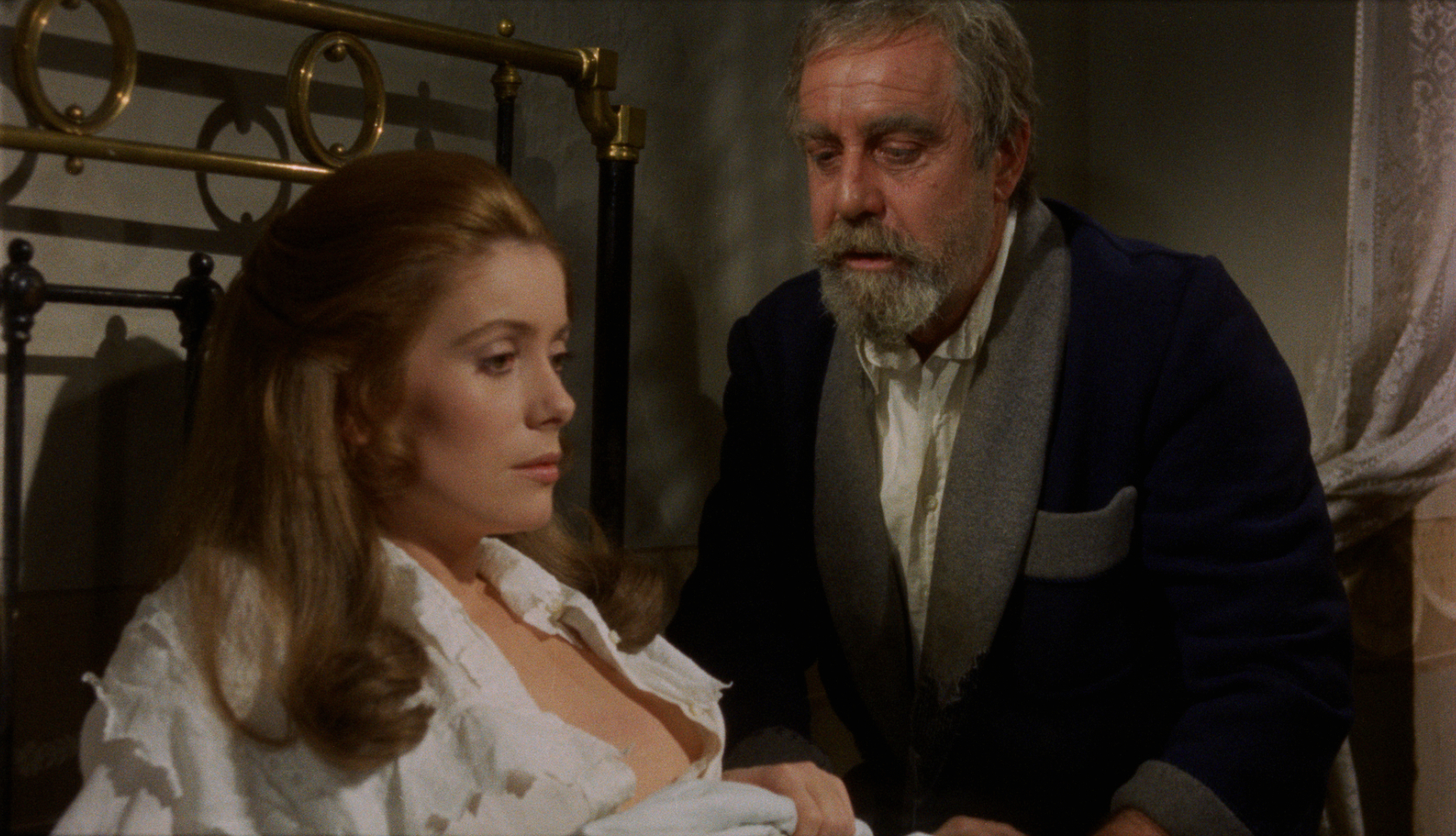
Otherwise, the classical “Tristana” plays like a 19th-century novel, with Catherine Deneuve (returning despite her misgivings over how Bunuel treated her in “Belle du Jour,” according to the commentary track), playing the title character. When her mother dies, Tristana is taken in by a local benefactor, Don Lope (Fernando Rey), who barely hides his lecherous intentions behind a veneer of arrogant propriety. Tristana chafes under his rule, even has a dalliance with a local artist (Franco Nero), but eventually succumbs to his advances.

What makes this different than every other story of a wronged ingenue is what happens after. Don Lope grows older, softer, lonelier, and becomes less controlling and more kindly towards Tristana. But she, older and more cynical, reacts to his newfound tenderness with seething rage. How dare he now become a human being? The upper hand has shifted, as “Tristana” moves towards its inevitable unhappy climax.

I liked “Tristana” quite a bit less than “Belle du Jour’ — I get that Bunuel’s game is to lull us into thinking the relationship is going one way, then suddenly changing course. But it’s a little dry until that change in direction, when Deneuve is finally able to offer a little more depth to her character. Rey is a delight all throughout, however, with Bunuel making merciless fun of a self-proclaimed “man of the people” who lets a thief get away because he’s a member of the proletariat, but is too pampered to actually work himself.

In addition to the commentary track with Deneuve and critic Kent Jones, the Blu-ray includes an alternate ending, a 30-minute featurette, and a 20-page booklet including Deneuve’s personal diary during the making of the film.

DVD review: “Collaborator”

collaborator

When someone says a movie feels “stagey,” they usually are referring to the setting, with the movie confined to a single or few locations.

But other times that can refer to the characters; for some reason, in theater you can get away with creating outsized characters that are archetypes in a way that you rarely can in movies. On stage, the actors are at a distance from the audience, so the acting almost has to be bigger, clearer. But the movie camera creates intimacy with the audience, and having a stereotype that close up often doesn’t work as well.

Canadian actor Martin Donovan’s debut as a writer-director, the thriller “Collaborator,” is stagey on both counts. I didn’t mind the confined locations at all, since the movie follows a hostage situation between two very different middle-aged men. What worked less well for me was Donovan’s insistence on making the two men each “stand” for half of America, or at least the halves of America he sees.

Donovan plays a Robert Longfellow, a once-promising playwright whose career has sunk to the point where he’s considering doing touch-up jobs on Hollywood horror screenplays. He returns to his childhood home in Reseda, California, where he meets an old childhood acquaintance, Gus (David Morse).

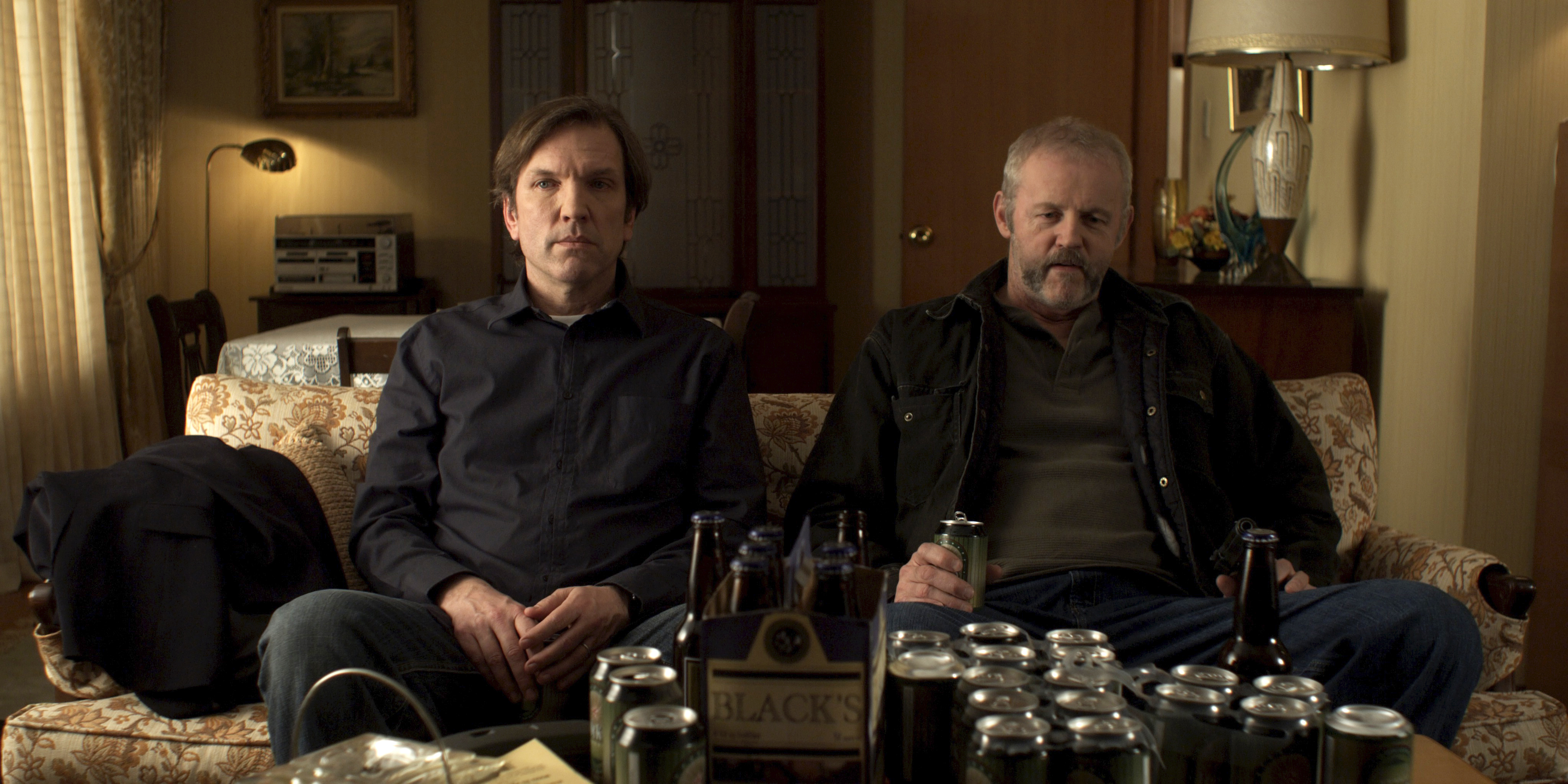
Gus is a hard-drinking, blue-collar right-winger, the polar opposite of the soft-spoken, liberal Robert. Gus also has some trouble with the law, and when the cops come a-knocking, Gus panicks and takes Robert hostage.

What follows is what’s know in theater as a “two-hander,” as the two characters drink beer and talk, Gus waves his gun around, and the two deliberately different men find common ground in their shared disappointments about how life has turned out.

“Collaborator” would have been much better if it had dropped the hostage subplot altogether. Donovan doesn’t seem interested in generating any tension from the situation, and the heart of the movie is really just the two men shooting the breeze. Both Donovan and Morse qualify for me as character actors I’d watch in anything, and they’re both good here, with Donovan’s paper-dry delivery playing off against the florid, raging Gus. Morse actually manages to make Gus both sympathetic and even funny, as when he gleefully agrees to talk on the phone with a famous Hollywood actress (Olivia Williams) who Robert knows.

But Donovan’s skill as a filmmaker is less proven; as I said, the screenplay draws both men fairly broad, defining them mostly by their red-state or blue-state tendencies. And the filmmaking is pretty uninspired, the camera often held still in a medium shot as he switches back and forth from one character in a conversation to the other.

The special features on “Collaborator” consist of a couple of interviews with Donovan and Williams that don’t tell you anything about their characters that you couldn’t glean from the film.

DVD review: “How to Survive a Plague”

how_to_survive_a_plague_1

It’s probably not surprising that David France’s Oscar-nominated film “How To Survive a Plague” didn’t win Sunday night. Oscar voters tend to gravitate towards straightforward and relatively safe subject matter when honoring documentaries, and they had a great example in “Searching for Sugar Man.”

But I hope the attention brought upon by the Oscar nomination will bring more people to see “Plague,” which is out on DVD today and streaming for free on Netflix Instant. Because while it is a devastatingly sad portrait of how the AIDS epidemic ravaged the gay community in America, it’s also just as hopeful and inspiring as “Sugar Man.”

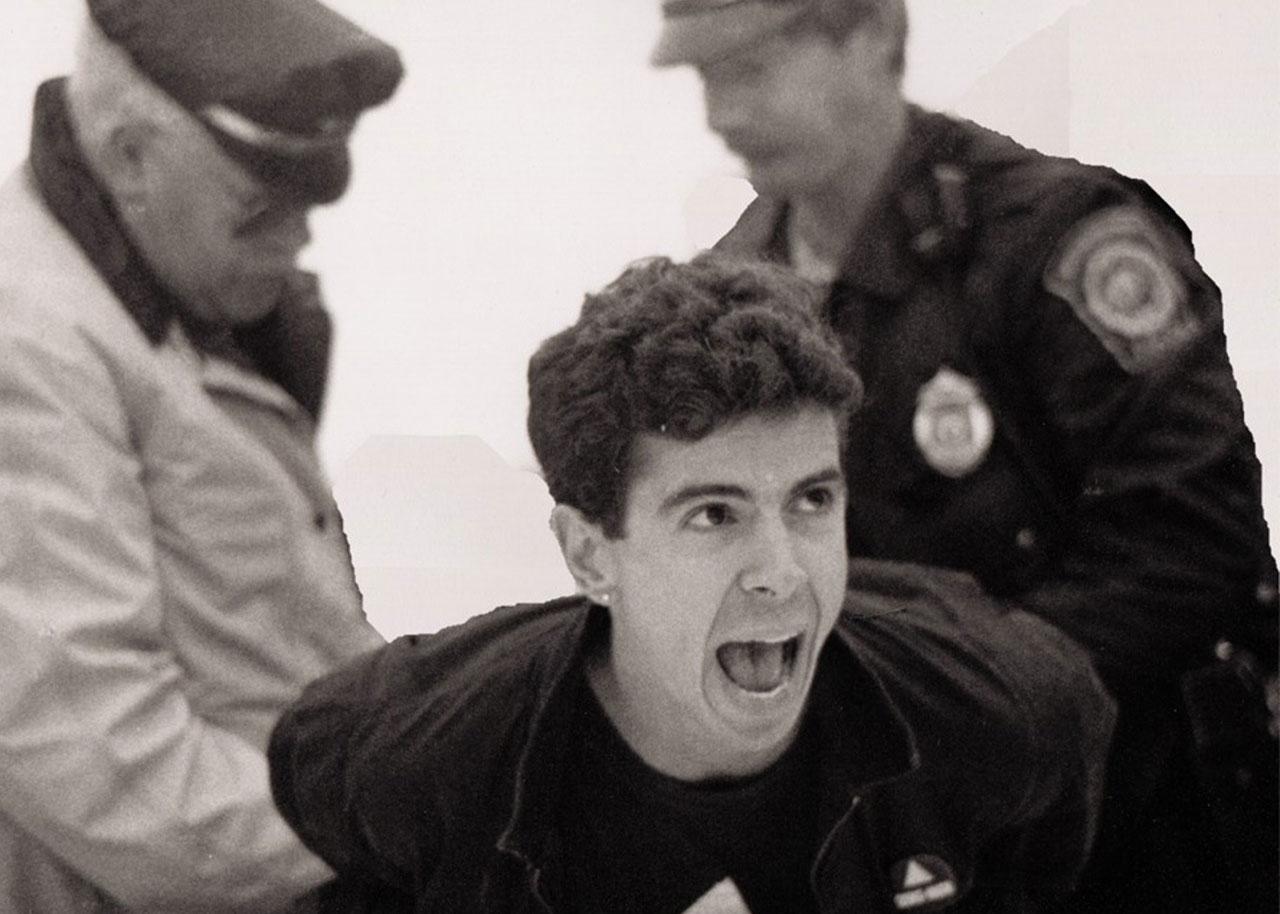
That’s because France focuses on ACT UP (and a later offshoot, TAG), a dedicated group of activists who kept up the pressure on the government, health officials and the pharmaceutical industry to hunt for a cure. In the 1980s, the task seemed hopeless, as the activists met a wall of indifference masking outright homophobic hostility, and an undercurrent that said gay people brought the plague on themselves.

Watch an episode of “Crossfire” featuring Pat Buchanan trying to goad activist Peter Staley into basically warning young people against being gay. Staley turns the tables, asking Buchanan which was preferable, thousands of dead people or gay people having safe sex. Buchanan clumsily dodges the question. Today he’s considered a crank, but in 1987 he was disturbingly close to the mainstream.

But ACT UP kept up, with public demonstrations (sheathing Jesse Helms’ home in a 35-foot-tall condom was a nice bit of media catnip), and private cajoling. The activists became experts on politics, on the law, and most importantly on science, and with their knowledge and persistence eventually got themselves invited into the labs to help researchers identify the most promising strains.

When the breakthrough finally comes in 1996, it’s a triumphant moment, but also a sad one; how many more could have been saved if the government hadn’t turned a blind eye for years? You see the survivor’s guilt in the eyes of the activists during present-day interviews: “Like any war, you wonder why you were the one that got to come home,” Staley says.

Aside from those interviews, France relies on never-before-seen archival footage of rallies and Greenwich Village strategy meetings to tell the story of ACT UP. He gets into the nitty gritty of scientific research, and of the complex nature of grassroots organizing, as factions develop and the group runs the risk of turning on each other in moments of despair.

But this is a story, if not of unvarnished triumph, then at least of perseverance, and a model for other grassroots movements facing their own seemingly unbreachable walls.

DVD review: “The Thief of Bagdad”

thiefofbagdad

I don’t know what the newest film will be to play at this year’s Wisconsin Film Festival, but I’ll bet I know the oldest.  The festival will show a digitally-restored print of the 1924 swashbuckling classic “The Thief of Bagdad,” starring screen legend Douglas Fairbanks.

It’ll likely be one of the most memorable screenings at the festival (April 11-18), akin to the Milwaukee Film Festival screening the restored “Metropolis” a couple of years back. But until then, the 2K restored version is out on Blu-ray this week from Cohen Media and is, in no uncertain terms, a stunner.

The restoration process, based off two original 35mm prints, took two months, and the result is a positively vivid picture. The sharp detail and depth of focus makes it look like one of those careful silent film recreations in “The Artist,” not a film that’s genuinely 89 years old. This may sound strange, but watching it, I could almost feel the wonder of early cinema, imagine how amazing it would have been for a 1924 audience to see lifelike characters moving around on a flat screen.

And the characters do a lot of moving around, especially Fairbanks; in the behind-the-scenes featurette accompanying the disc, historian Jeffrey Vance explains that there are relatively few on-set photos of Fairbanks simply because he was always in motion, moving too fast and too much for the still camera to capture him. His barrel-chested, broad-grinning dynamism shines through in “Thief,” considered his masterpiece, as he plays a lowly street thief who gets embroiled in a scheme involving a beautiful princess and an evil suitor. Fairbanks is lithe and graceful throughout — watch him shinny up a rope to a balcony to steal some food, or hang on the underside of a carriage, insouciantly grinning as he plucks the rings off the fingers of the unwise royal passenger snoozing within.

Using gigantic, expressionistic sets to invoke the palaces and minarets of a Bagdad that only exists in the imagination, along with state-of-the-1920s-art visual effects for the flying carpets, invisibility cloaks and other flights of fancy, this may be one of the first Hollywood films to justify the overused term “epic.” (Raoul Walsh is credited with directing, although it’s widely perceived that Fairbanks was the actual man in control.) Instead of stark black-and-white, the images recreate the original tints of the theatrical release, which means that the outdoor scenes have the yellow of old parchment, the night scenes a steely blue, the indoor scenes a lustrous pink.

Add in an absolutely fantastic full-orchestra score by composer Carl Davis that quotes liberally from the works of Rimsky-Korsakov, and you’ve got a true classic of early cinema brought back to its original glory.