“Renoir”: Colored perceptions between father and son

renoir

“Renoir” opens Friday at Sundance Cinemas. R, 1:51, three stars out of four

If only Pierre-Auguste Renoir had the colors at his disposal that director Gilles Bourdos has in making a movie about him. The French drama, set at Renoir’s country estate on the French Riviera, practically vibrates with beautiful colors, mostly bright oranges intertwining with deep greens. One shot, in which the famous Impressionist painter dips a dirty brush in a clear glass of water, and the vermillion paint swirls like flames inside the glass, is so gorgeous you almost have to look away.

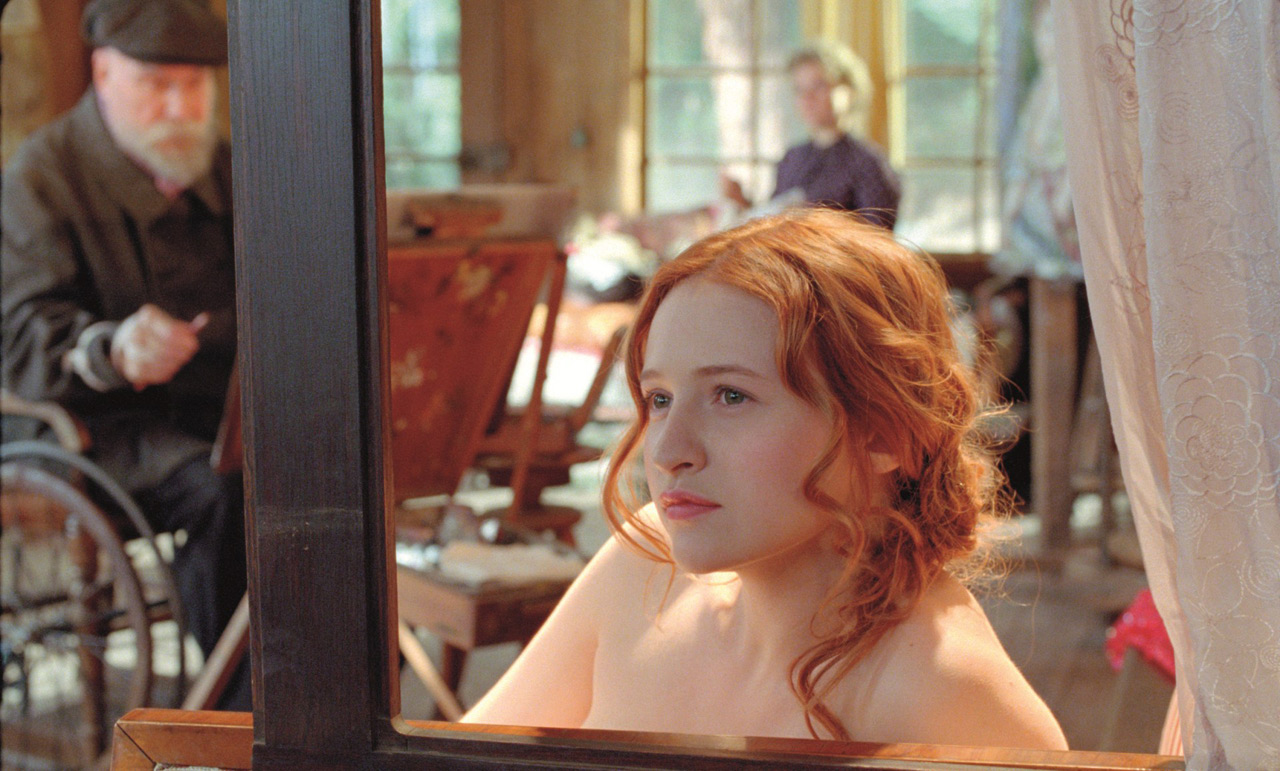
It’s that eye-popping surface that is the real star of “Renoir,” although the film is an agreeable if shallow look at the great artist in the twilight of his years. At 74, Renoir (Michel Bouquet) is confined to a wheelchair; he could probably still walk, but it would take a lot of effort, and that effort he wants to pour into his last paintings. Renoir is prone to grand pronouncements about the nature of art, such as the prettiness of his paintings (“There are enough disagreeable things in life. I don’t need to create more.”) but beneath that crusty facade is a man with a purely carnal streak, obsessed with the glow and texture of a woman’s skin. His household is full of former models, who became maids as they aged, and it’s understood that Renoir knew more than one of them in an artistic sense.

The latest model to come to him is Andree (Christa Theret), a beautiful and tempestuous young woman who inspires him on the canvas and in his heart. The film lingers on scenes of Renoir painting her, and the process is quite fascinating to watch, as he draws quick brushstroke curves on the canvas, seeming to will them to converge into the natural curves of the human form.

Then Renoir gets another visitor, his middle son Jean (Vincent Rottiers). Jean is on leave after being injured in World War I, and yearns to be back with his comrades on the front lines. Cinephiles will know that Jean someday becomes a great film director (“Rules of the Game,” which just played at UW Cinematheque a couple of weeks ago). But there’s not really much more than a hint of that in “Renoir,” other than the dreamy look Jean gets on his face when he sees a silent film projected on the wall.

Jean and Andree fall for each other, of course, and I found their whole romance kind of trite, especially when they tussle about whether he should go back to the war. Pierre-Auguste is by far the most interesting Renoir of the bunch, and “Renoir” is much better in those quiet, lovely scenes of him painting, his crinkled eyes observing, the occasional pronouncement croaking forth from somewhere deep beyond that majestic beard. Bouquet makes him an imposing figure, but finds a twinkling humor beneath his fearsomeness.

When his doctor asks him what he’ll do when his hands are too old and shaky to paint with, Renoir responds flatly, “I’ll paint with my dick.” Which, the film suggests, he always has.

“The Company You Keep”: Redford is a radical on the run

The-Company-You-Keep_04

“The Company You Keep” opens Friday at Eastgate and Sundance Cinemas. R, 2:05, 2.5 stars out of 4.

What’s the one thing I never thought I’d see missing from a political thriller directed by Robert Redford? Politics.

“The Company You Keep” is a film about former ’60s antiwar radicals on the run decades later, but it takes no stand – has no interest, really – on the rightness or wrongness of what they actually did. Instead, it’s an intriguing thriller with a heavyweight cast from top to bottom that only intermittently realizes its potential.

Redford stars as John Grant, a do-gooder lawyer in upstate New York. When a member of the Weather Underground (Susan Sarandon) is captured nearby after 30 years on the run and charged with the murder of a bank guard, Grant declines to take her case. Which strikes ambitious local newspaper reporter Ben Shepard (Shia LaBeouf) as a little odd, since it’s the sort of bleeding-heart case that Grant would usually jump at.

So he greases some palms in local government, pulls at some threads, and discovers that Grant himself is a former member of the Underground, Nick Sloan. Grant/Sloan goes on the run, reconnecting with a web of old comrades (Nick Nolte, Richard Jenkins, and Julie Christie among them) as he crosses the country (including a quick stop in Milwaukee).

Meanwhile, Shepard digs into the Michigan bank case and starts raising doubts about Sloan’s guilt. The film criss-crosses between both characters before they finally reunite in remote mountain cabin, the FBI closing in.

I’m not quite sure, in the broadest strokes, what Redford or screenwriter Lem Dobbs (“The Limey,” “Haywire”) were going for here. They don’t want to re-litigate the politics of the Vietnam era, for sure. But the film only makes a passing attempt to be a tense “Fugitive”-like innocent-man-on-the-run style thriller. (And Terence Howard, who plays the FBI agent in charge of the manhunt, is no Tommy Lee Jones.)

The overarching theme seems to be that of reflection, of old firebrands reckoning with what they did as young radicals, and if it was worth it. “We’re a story told to children now,” Sloan says at one point. “But I’m glad somebody’s still telling it.”

If the energy and purpose of the overall film flags at times, there’s still enough to hold your interest in “The Company You Keep.” That’s largely due to the almost ridiculously high-level cast, including not only the names mentioned above but Stanley Tucci, Sam Elliott, Anna Kendrick and Chris Cooper. By the time Brendan Gleeson and Brit Marling appear late in the film as the retired detective in charge of the bank robbery case, and his daughter, I actually laughed out loud. It’s like the “It’s A Mad, Mad, Mad, Mad World” of political thrillers.

Redford seems more concerned with keeping all the characters and all the different threads of plot from getting tangled, and I think he keeps a steady hand on the till. He’s so concerned with story that he’s less successful with giving his cast enough room to breathe, but there are moments that shine. Sarandon has a dynamite interrogation-room scene that rings with both exhaustion and conviction, and Redford and Christie spar effectively in a scene late in the film over the legacy of the Weather Underground.

But the breakout star, shockingly for me, was LaBeouf, an actor I’ve never particularly cared for. His Ben Shepard is one of the best portrayals of a journalist I’ve ever seen in a film, a mix of drive and pride and ambition, often confusing personal ego for the public interest. It’s not a terribly likable portrait but it rings true, one of those last, flawed crusaders in a slowly dying print newsroom.

“Room 237”: Film obsessives check in, but they don’t check out

room_237_documentary_trailer_athensbars

Room 237″ opens Friday at Sundance Cinemas. Not rated, 1:38, 3.5 stars out of 4

You know when “Room 237” starts getting really scary? When the people in the film start making sense.

Rodney Ascher’s playful and engrossing documentary looks at another film, Stanley Kubrick’s “The Shining,” through the perspectives of five absolutely obsessed fans. And I don’t mean obsessed as in “watches it every Thanksgiving” or “has the poster framed in their rec room.” I mean obsessed as in doing frame-by-frame analyses of the film, looking for hidden objects, continuity errors and other Easter Eggs they believe Kubrick left there to support their theories.

One critic insists that “The Shining” is really Kubrick’s veiled confession that he was involved in faking the footage of the Apollo moon landing. Why else would the sign “Room N. 237” be so prominent in one shot, if it wasn’t an anagram of “moon”? (Plus an ‘R”, I grant you.) Another sees cans of food in the hotel kitchen bearing the likeness of a Native American chief, a clue that Kubrick has really made a movie about the betrayal of Native Americans.

A repeated phrase throughout the film is a variation on “Most people wouldn’t catch this, but . . .” and goes on to make some connection that absolutely nobody would see (such as, supposedly, Kubrick’s face superimposed in the clouds during the opening credits). The obsessives always assume that they have some secret connection to the film that allows them to see what’s really going on. An interest in Holocaust history, for example, makes one uniquely qualified to see the Holocaust references in the film, such as a German typewriter. The thought never occurs to them that they are imposing their own interpretations onto the film. If these are conspiracy theories, it’s a conspiracy of two people — Kubrick and the “enlightened” obsessive.

We never see these theorizers; instead, we hear their voices throughout the film, which visually is made entirely of clips from “The Shining” and occasionally other movies. Fitting, of course, because these obsessives can’t see beyond the frame of the film. As one puts it late in the movie, they’re as trapped in the Overlook Hotel as much as Jack Torrance, doomed to roam around and around its halls, looking for patterns, looking for answers. When another fan talks about playing “The Shining” simultaneously backwards and forwards, one image imposed upon the other, it’s a perfect visual metaphor, turning the film into an endless Moebius strip to get lost in, with no entrances and no exits.

But then somebody actually makes a good point, and it jars you. For example, one woman points out that, in the scene where Jack is talking to the hotel manager in his office, bright sunlight is pouring through the window. However, if you examine the layout of the hotel, that office should be right in the center of the building, with no access to an outside window. So we may scoff at these outlandish theories, but a healthy dose of respect should go along with that; they may be seeing a lot that isn’t there, but they’re seeing some things that are, too.

So where is the light coming from? Was it a just a continuity goof-up, or was Kubrick making some sort of secret metaphor? Or, more likely, did he just think it looked right for the shot, and never a million years expected that diehard fans would be studying his film so closely?

Either way, “Room 237” is both kind of an affectionately cracked ode to filmophilia as well as a warning sign as to its perils. And it’s also the greatest recommendation ever to go watch “The Shining” again.

“Upstream Color”: Shane Carruth goes whole hog with strange and brilliant film

UpstreamColorStills_0001_Screen-Shot-2012-12-04-at-3.14.41-PM.png

“Upstream Color” is now playing at Sundance Cinemas. Not rated, 1:38, four stars out of four. I’ll be doing a post-show chat following the 7:05 p.m. show Monday at Sundance Cinemas.

At heart, “Upstream Color” is about a woman who escapes a controlling relationship and finds love with another equally damaged soul.

It’s just that the controlling relationship involved mind-controlling worms, the new love affair seems to be connected with psychic pigs, and “Upstream Color” is like no other movie you’ve ever seen. Even if you loved writer-director-star Shane Carruth’s mind-bending first feature “Primer” back in 2004, you might be utterly befuddled by his long-awaited follow-up.

While “Primer” was narratively dense, it was a time-travel thriller that traveled down a set of tangled but discrete narrative pathways, if you took the time to sort them all out. “Upstream Color,” meanwhile, is much more abstract and elliptical, leaving fuzzy patches in the story for the audience to make connections. Some might find that frustrating; I found it one of the most invigorating and intoxicating movie experiences of the year.

The first 20 minutes or so, I think I have a pretty clear handle on. Kris (Amy Seimetz) is abducted by a man (known only as The Thief in the credits) who forces her to ingest a small parasite that gives him absolute and total control over her mind. He can convince her not to feel hungry even if she hasn’t eaten for days, convince her to copy pages and pages of Henry David Thoreau’s “Walden” without question, and, oh, he can get her to turn her life savings over to him. It’s a scary sequence, seeing how completely Kris’ will and identity is turned over to a stranger, all because of a little mealworm.

When The Thief has drained her dry, he leaves, and Kris is left to pick up the pieces of her life. The worm in her body is drawn out by a pig farmer (Andrew Sensenig, known in the credits as The Sampler) who implants it in one of his animals. Here’s where it gets hazy — the worms seem to retain some kind of psychic residue of its human host, and The Sampler can use sound effects to access those memories. It’s seemingly a more benign form of mind invasion than The Thief’s, but no less intrusive.

Kris falls in love with Jeff (Carruth), who it turns out has been through the same experience with The Thief and The Sampler. What surprised me in the midst of all the sci-fi overtones is how raw and affecting their relationship is — Kris’ abduction has filled her with a rage-filled wariness at others, and the pair chafe and snap at each other before finally finding some kind of harmony. Amid all the narrative arabesques and visual splendor of “Upstream Color,” the honesty of that relationship, and especially of Seimetz’s performance, shouldn’t be overlooked.

“Upstream Color,” as far as I can tell, is about realizing that unseen, distant forces have a powerful hold on your life, and figuring out a way to wrest control back again. Or not — this is a film that leaves things way open to interpretation, and I would hate to impose my narrative upon the one you find. (That would certainly run counter to the theme of the film, wouldn’t it?)

While “Primer” was made for $7,000 and looked like it was built in a garage, “Upstream Color” is flat-out beautiful to look at, Carruth composing images with a Terrence Malick-like attention to depth of field and light. Images of the natural world — the worms, those cute pigs, and an unearthly blue orchid — play a major part in both the story of “Upstream Color” and its visual aesthetic. Watching it feels, in the best way, like a form of hypnosis.

Wisconsin Film Festival review: “Stories We Tell”

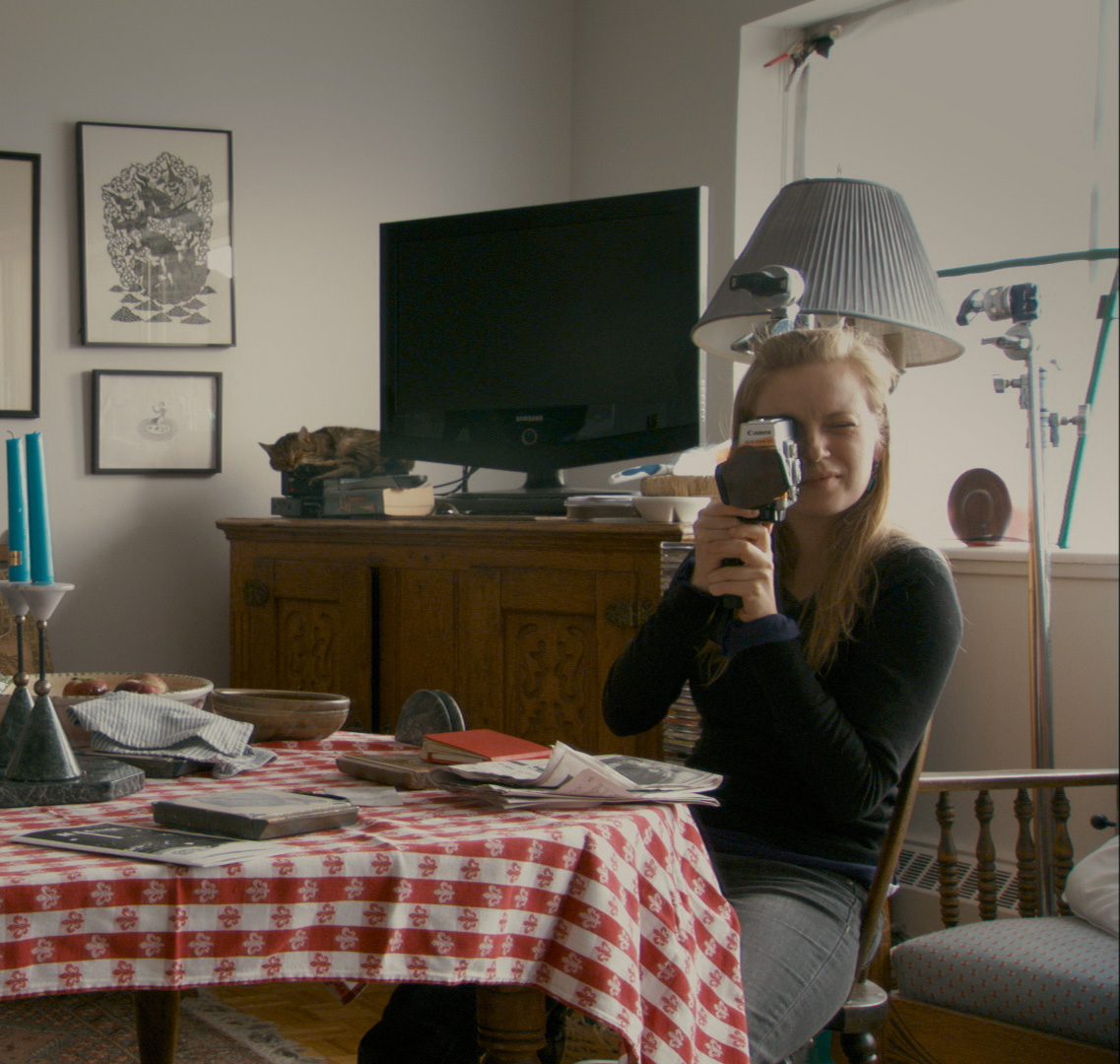
stories-we-tell-sarah-polley-super-8-cam

From the beginning, Sarah Polley opens the hood of her documentary “Stories We Tell” and shows the machinery whirring inside. The film begins with her and her father entering a recording studio, and a montage of Polley and her crew setting up cameras and lighting for the film’s interview subjects.

It’s an introduction that’s tantamount to a magician’s “nothing-up-my-sleeve” insistence, because Polley has something far more interesting and unusual in mind that the typical nuts-and-bolts documentary. “Stories We Tell” is a powerful and very personal story from Polley, but she’s also constantly mindful that it’s a “story,” a series of facts and opinions shaped into a narrative, and as such isn’t entirely to be trusted.

And this is, in a very literal sense, Polley’s story. The film digs deep into the lives of her parents, Mick and Diane Polley, who met on the Toronto theatrical scene. Mick cut a dashing figure onstage, while Diane was beautiful and vivacious, the sort of woman who “make the record skip” when she walked into a room in more ways than one.

As Mick settled into kind of a middle-aged fog, Diane grew frustrated, and took an acting job in Montreal in 1978 that took her away from home for a couple of months. What happens next, the viewer should discover from the film, as Polley digs through layers after layers of reminiscences and rumors, interviewing her four siblings and friends of the family.

As we’re following the sudden revelations of the story — and there are some doozies, expertly revealed by Polley as she shifts from perspective from perspective — we’re also becoming aware of how each account differs. Some people have the facts a little off, others just view the same facts differently than others. One man, who seems to be just a supporting character in the drama, insists that his account and only  his is the truth, and all the others are just noise.

The closest the film has to an authority is Mick, who reads from his writing about the family history in plummy, theatrical tones throughout the film. But even he doesn’t have the full picture of his own family.

The perspective that is largely missing, ironically, is Polley’s — although we see B-roll footage of her about to be interviewed, it never appears in the film. Instead, she seems to be getting at the truth of her life the way a submarine uses sonar, pinging off the other people in her life until she finds a spot that overlaps. It’s a fascinating process, and Polley (an actress turned acclaimed director of the dramas “Away From Her” and “Take This Waltz”) blends the different voices expertly until a bigger picture emerges.

The film also weaves in Super 8 home movie footage of Diane and the family, although it turns out that the way Polley is telling the story contains as many secrets as the story itself. Put it this way; critics who like their documentaries the way Joe Friday likes his witnesses — “Just the facts, ma’am” — are going to have a big problem with this movie.

For me, it’s a brilliant film that manages to be both one family’s shared history and all families’ shared histories. Would “Stories We Tell” have been as compelling if Polley didn’t add all the post-modern devices to it? On the level of pure storytelling, probably. But the way she tells the story takes it beyond “What happened?” and forces us to examine the too-tidy narratives of the stories we tell ourselves.

Wisconsin Film Festival review: “Key of Life”

KEY-OF-LIFE-2012.mp4_snapshot_01.11_[2012.11.05_23.32.33]

Oh, you could make such a terrible Hollywood remake of “Key of Life.” The pieces are all there, just waiting for some hack screenwriter to mess them up.

But it hasn’t happened yet, so enjoy the dizzying original Japanese screwball comedy while you can, which had two screenings at the Wisconsin Film Festival this week.

The premise is classic high-concept comedy; wannabe actor and all around loser Takeshi (Masato Sakai) sees an opportunity in the bathhouse when another bather slips on a bar of soap and is knocked out cold. Takeshi quietly switches locker keys with the unconscious man, steals his clothes and cash out of his locker, and hightails it out of there.

Only it turns out that he has switched identities with a cold-as-ice hitman, Kondo (Teruyuki Kigawa). Driving Kondo’s car and living in Kondo’s fancy apartment, Takeshi is mistaken for the killer and roped into doing some unfinished business for the local yakuza.

The real Kondo, meanwhile, has amnesia, and settles into in Takeshi’s old sad-sack existence. But he’s happier than he ever was as a contract killer, especially after he meets magazine editor Kanae (Ryoko Hirosue) who has marked her wedding date on her day planner. Now she just has to find a husband, and Kondo seems as good as any.

Writer-director Kenji Uchida has written a crackerjack script, one with jokes that detonate right away and others that lay fizzing for most of the film before suddenly exploding when we least expect them too. At over two hours, “Key of Life” could have been a little snappier in the pacing department, but the energy level and inventiveness never flags, and when the comics twists and turns come along, they’re beautifully executed.

“Key of Life” was picked up for U.S. distribution by Film Movement, which bodes well for a DVD release.

“From Up on Poppy Hill”: Studio Ghibli finds magic in the mundane

poppyhill

“From U p on Poppy Hill” opens Friday at Sundance Cinemas. PG, 1:31, 3.5 stars out of 4.

There are no moving castles in “From Up on Poppy Hill.” No witches, no fishes who turn into children, no little people living under the floorboards.Madison movie fans who have been regulars at the Sunday afternoon “Cinematheque at the Chazen” Studio Ghibli retrospective series this year, they know that it’s not unheard of for the legendary Japanese animators to take a break from fantasy films. But for most Western audiences, who know Ghibli through “The Secret World of Arrietty,” “Spirited Away” and “Princess Mononoke,” the relatively ordinary plot of “Poppy Hill” might seem like a bit of a shock.

But don’t worry, because “Poppy Hill” really takes place in two magical, powerful kingdoms that exist in the same place with each other. One is called the Past. The other is called the Future. And the wonderful “Poppy Hill” has, in its own gentle way, many wise and warm things to say about the difficulties of trying to live in both.

Umi (voiced in the English-language version by Sarah Bolger) is a teenage girl living in Yokohama in 1963. Her father was lost at sea during the Korean War, and her mother is at school in the United States, but Umi is very capable, and can not only get her two younger siblings off to school, but can run a small boarding house out of their home as well. Yet, every morning, she goes out and raises the naval flags outside her house, in the faint hope that they will someday guide her father home.

All around her, Japan is excited about the 1964 Olympics coming to Tokyo, and the country is in the midst of a cultural shift, trying to push away the painful past of World War II and look towards a bright future. At Umi’s school, that mindset comes to a head around the student clubhouse, a ramshackle old building nicknamed the Latin Quarter. The towering building houses all the clubs at school — the Archaeology Club, the Chemistry Club, even the one-man Philosophy Club — floor after floor of nerds stacked on top of each other. But the administrators see it as an eyesore and want it torn down before the world comes to Japan for the Olympics.

Leading the student revolt is Shun (Anton Yelchin), who we first see leaping off the roof of the Latin Quarter and into a pond as a publicity stunt. Together, with Umi leading the girl students and Shun leading the boys, they try to whip the clubhouse into shape. Shun and Umi also fall in love — the most chaste, platonic love you’ll see on a movie screen in quite some time. But that love is threatened when the pair learn of a secret connection between their fathers, dating back years, that could scuttle their relationship.

“It’s like a cheap melodrama,” grumbles Shun, which is a great joke, because of course in the hands of Studio Ghibli it’s anything but. The film was written (“planned”) by Ghibli’s master filmmaker Hayao Miyazaki and directed by his son, Goro Miyazaki. It almost goes without saying how beautiful the hand-painted animation of “Poppy Hill” is to look at, whether it’s the millions of tiny details in the labyrinthine Latin Quarter, or the evocation of a 1960s Japan street scene, with the peppy Japanese pop hit “Sukiyaki” playing on the soundtrack.

But “Poppy Hill” proves to be more than just a visual feast. It’s seemingly slight storyline has a warm emotional resonance, tapping into both the uncertainty of a Japan caught between past and future, and adolescents Umi and Shun, caught between childhood and adulthood. Most movies posit the teenage years as someting to be endured, so it’s such a treat to see Umi and Shun taking charge of their lives, at home and at school, learning how to master their regrets and uncertainties. It’s easy to build up a lot of empathy for these characters, and the hope they carry forward with them.

In my household, the film was perhaps a bit too slow and fairy-free for a 5-year-old who loved “Arrietty,” but the 9-year-old was captivated. As was the 44-year-old.

One further note: like many recent Studio Ghibli imports, the film is dubbed into English rather than subtitled, and in the past the English versions have been rather poor, with colorless dialogue and flat vocal performances. The translation in “Poppy Hill” feels a cut above those recent efforts, though, with Yelchin and Bolger turning in appealing performances ahead of a large supporting cast that includes Aubrey Plaza, Bruce Dern, Jamie Lee Curtis and Gillian Anderson, as well as a very funny surprise cameo by Ron Howard.

Wisconsin Film Festival review: “Cheap Thrills”

cheap_thrills_credit_

Between last year’s “Compliance” (which he also brought to the Wisconsin Film Festival) and this year’s “Cheap Thrills,” actor Pat Healy is cornering the market on a special kind of horror movie.

Sure, the two movies couldn’t be more different in tone. “Compliance” is a stomach-twisting moral nightmare in which a phone prankster convinces a fast-food manager to detain and abuse an employee. “Cheap Thrills,” which screened Saturday night, is a raucous pressure cooker that dishes out laughs and shrieks with equal measure.

But at heart, both are horror movies. They’re just not horror movies that try to make us afraid of a vampire, or a serial killer, or some other evil entity out there. They try to make us afraid of ourselves, what good decent folks like us are capable of.

“Compliance” played on our unthinking obedience to authority figures. “Cheap Thrills” makes us question what we would do for money, if we were desperate enough and there was no chance of anyone finding out.

Craig (Healy) is plenty desperate. In a few deft strokes, essential for spelling out the stakes of the film, Katz shows us how Craig is in trouble; he’s got a wife and infant son in an apartment he’s about to be kicked out of, and just lost his job as an auto mechanic, a long step down from his failed dreams of being a writer. In a daze, he stumbles into a dive bar and meets Vince (Ethan Embry), an old high school buddy turned low-level enforcer. He’s tougher than Craig, but in his own way he’s just as desperate as Craig.

And the a wealthy couple, Colin (David Koechner) and Violet (Sara Paxson) calls them over to their table. Colin is dropping $100 bills like they were about-to-expire Groupons, and buys round after round of expensive tequila. He suggests a friendly bet to Craig and Vince for $100. Then another friendly bet for $200.

Eventually, they head back to the couple’s house. And the bets start getting a lot less friendly.

As the dares get more and more depraved (and lucrative), “Cheap Thrills” gets more outrageous and more disgusting. But Katz and screenwriters Trent Haaga and David Chirchirillo, along with the foursome of actors, always keep track of the relationships among the four characters. Who wins one bet isn’t as important as how it strains the friendship between Vince and Craig, getting them to turn on each other. And how back-slapping Colin and the seemingly bored Violet manipulate them into vying for more and more money. The horror doesn’t come from what Colin offers them. It comes from Vince and Craig eagerly accepting, even low-balling each other for the opportunity to debase themselves.

One of the most telling moments in the film comes, in the middle of some out-there dares, when Colin idly offers $300 to the first guy who can fix him a vodka tonic. Vince jumps at the chance, like an obsequious waiter, and Colin knows he has him. Vince just sold his dignity for $300. “Cheap Thrills” is all about what lines you’re willing to cross, and for what. The parallels are there to larger forces in American life, whether it’s reality television, or moneyed interests pitting one segment of the lower classes against the other (“Unions are ruining America!”) But the movie never overstates this, focusing on everyman Craig and his bizarre, bloody quest to bring home the bacon.

Healy gives such a fearless and funny performance as Craig, and Embry draws lots of laughs as the tough guy who can’t believe how far his nerdy friend will go. Koechner, best known for big comic parts in “Anchorman” and on “Saturday Night Live,” brings just the right dose of menace and condescension beneath Colin’s jovial exterior — he’s like a sociopathic Bill Murray. Paxson, who also worked with Healy in “The Innkeepers,” is quietly unnerving, as Violet casually snaps away on her camera phone at all the mayhem.

In the post-show Q&A, Healy said he really liked how the screenplay made every step Craig takes seem utterly believable, no matter how strange things get.

“The role had everything I would want to do in a movie,” he said. “What excites me the most about any part is a real arc, that goes from Point A to Point Z, and that it charts logically, as crazy as it is.”

Saturday’s screening was the Midwest premiere of the film, which opened last month at South by Southwest and was immediately snapped up for distribution by Alamo Drafthouse Films.

Wisconsin Film Festival review: “A Hijacking”

ahijacking

“A Hijacking” tells its tale as plainly as its title, without Hollywood action, without true heroes or villains, without the expected emotional button-pushing (there’s hardly even any music on the soundtrack.) What it is an authentic, suspenseful film about seemingly real people dealing with an unreal situation.

Mikkel is the cook on a ship heading for Mumbai. Peter is the CEO of the company that owns the ship. When Somali pirates storm the ship, Mikkel is appropriately terrified. Back in Denmark, Peter demands to handle the ransom negotiations himself over the objections of his counter-terrorism adviser. We’ve just seen Peter close a big deal, and he seems like the right man for the job, almost superhumanly unflappable.

But as days turn into weeks, weeks into months, the tension takes its toll on Peter. Meanwhile, back on the ship, Mikkel must learn to cope with constant terror. The Somali translator Omar is almost kindly, insisting this is a business transaction. The rifles being brandished say otherwise.

One would assume writer-director Tobias Lindholm would keep most of the movie on the  ship, since that’s where the action is. But he wrings a surprising amount of suspense out of the board room as well, often building drama through the separation between the two locations. Mikkel, trapped on the ship, can’t understand  why his boss doesn’t just pay the money. Peter’s only connection to his crew is a shaky phone connection; at one point, we hear a gunshot over the line, but don’t find out what happened until several scenes later.

The press notes say some of the actors involved in the film have lived through similar experiences; the actor who plays the counter-terrorism adviser used to be one. You can tell right away; this is a film that doesn’t use Hollywood conventions to let the viewer off easily.

Wisconsin Film Festival preview: “This is Martin Bonner”

this-is-martin-bonner-paul-eenhoorn

“This is Martin Bonner” screens at 6:30 p.m. Saturday at Sundance and 2 p.m. Sunday at the UW Elvehjem. Writer-director Chad Hartigan will talk at both screenings.

The 15th annual Wisconsin Film Festival starts today! And while I’ll be shifting from “preview” mode to “review” mode in just a few hours, I couldn’t let one lovely little gem of a film slip by unmentioned.

In most movies, Martin Bonner would be a memorable minor character, the sort where you’d idly wonder “What’s that guy’s story?” Chad Hartigan’s second feature gives Martin that movie, and the results are quietly astonishing.

Martin (Paul Eenhoorn) is a man in his 50s who lives in Reno, Nevada and works as a counselor for inmates at the local correctional facility. Eenhoorn, a fine Australian character actor, plays Martin as a good man, but one who keeps the world somewhat at a distance. As the film unfolds, quiet conversation by quiet conversation, we learn that Martin self-detonated his old life in Maryland — getting divorced, getting fired from his job, losing his faith — and has come across the country to — start again? Or simply to spend the rest of his days alone, away from the prying eyes of everyone who knows him? Hartigan, and Eenhoorn’s warm performance, keep us guessing.

Martin meets Travis Holloway (Richmond Arquette), a recently paroled inmate in his program. Travis is also trying to restart his life, starts attending church, tries to reconnect with his grown daughter. Even though Travis is perhaps a decade or so younger than Martin, he seems older, wearier. The two men are facing the world alone, the sum of the bad choices they’ve made etched in their faces. Slowly, they become friends, but the wary sort of friends that middle-aged men make, when they’re not sure if they have the room in their lives for another connection.

“This is Martin Bonner” tells its story at its own pace, which might seem frustratingly slow to some, but felt just right to me, riding the real cadences of everyday life. Both men spend a lot of time alone, with their thoughts, and the film reflects that almost monastic existence in its tone. But then, all of a sudden, Hartigan includes a scene that’s so stunningly lyrical as to take your breath away, such as Martin refereeing a girls’ soccer game, the field nestled right up against the looming mountains, or an incredible 360-degree pan of a bleak highway scene, all motels and storage tanks, the future that Travis sees for himself.

Both Eenhoorn and Arquette give layered, honest performances, not straining against expectations so much as just allowing Martin and Travis to be authentic human beings. The film pulls you into their lives, and when the time came for the screen to finally fade to black, I was so invested in their story that it was kind of a shock to see it end.